
Living with 4K - No disc? The end of Collecting Movies?
The Players
As mentioned in the previous article of this “Living with 4K series two companies (Red and Sony) have announced their solution for playing 4K content on the new Ultra-HDTV displays introduced in 2012 and showed at CES 2013 in much larger selection by many manufacturers, including Samsung, Sony, LG, Sharp, Hisense, Westinghouse, Vizio, and Radio Shack (just testing if you are paying attention).
One common denominator of these two companies is that their 4K players are not disc based, such as a new Blu-ray disc with larger capacity and more efficient compression for 4K could be, the units rather download, store, and playback 4K content using an Internet connection and an internal hard disc drive, like one would do using a computer.
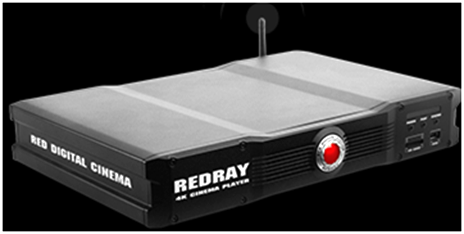
Red's 4K player is called, guess what?, Redray, with an MSRP of $1450, available early in 2013 the company says, check the previous article for technical details. The player uses a 4K service provider: Odemax, that was announced to be live by March 2013.
Sony's player and 4K movie service were announced at CES 2013 as to be available by mid-2013, check also the details in the previous article. In addition, Sony already has a 4K server the company lends to the buyers of their new $25,000 4K panels so they appreciate what their panel can do with 4K quality content, rather than just up-scaling 1080p Blu-rays. The server has stored a few 4K movies, not necessarily the latest hits, and is configured as a Dell PC, which is not compatible with the Sony 4K projector, I will receive a compatible server in a few days and test it for a review, so stay tuned.
I am also scheduled to review the Redray 4K player when the company can make one available for a review, and, when Sony makes available a review unit of their near future 4K player, I plan to do the same. 
But this article is not about players, is about the, arguably loud and clear, message these announcements are giving to movie collectors, those that for years have been accustomed to buy their own movies for their collection with the best audio and video quality there is, because watching a movie is just one of the pleasures of having it, the feeling of ownership of a collected item cannot be replaced by Internet content, but I know many would not understand that concept and still listening to an over-compressed MP3 version rather than buying the CD.
The Message
The message seems to be clear from Redray because their purpose is primarily to distribute content with Odemax to theaters and to those that buy their player, or their projector with the incorporated player, and Red has developed their own very efficient compression algorithm for the 4K content to require no more than what HDTV broadcast requires today.
But the message is not 100% clear from Sony because their mid-year server maybe a message of a) forget about a 4K disc, ever, or b) there is no disc yet but we can offer you a way to consume 4K content for the time being, not necessarily admitting it as in lieu of future pre-recorded discs, but to rather fill a hole until there is one, or even after there is one, but the reality is: if there is one.
As I mentioned in my other article the Blu-ray Association consistently declared for over a year that they are NOT working on a 4K disc solution, but you may join me in the analysis below in that such statement may not be telling anything other than not saying “we want Blu-ray to be alive for a few more years and we do not want to cause an stampede of people stopping buying Blu-ray discs if we announce that 4K ray spec standard is coming.
Regardless if a 4K disc would be available or not, as a consumer of content I like to have alternatives, rather than being imposed a format or service that follows a mass trend of streaming and downloading mediocre quality because it may be practical to most people.
Additionally, judging by the high number of LCDs people buy, rather than quality plasma imaging, and their interest of viewing over-compressed Internet content with Smart TVs, the message is loud and clear that the audience does not appreciate quality, or does not know how to appreciate quality, and unfortunately, judging by the down hill of brick and mortar good audio/video stores that can properly educate the public with quality demonstrations, the end result would be similar, besides, mediocrity with a red tag is what sells, and is here to stay.
The Impact to Movie Collectors
As some of you already know, I am a movie collector since the era of laserdisc and original aspect ratio pre-recorded movies, and, until the audio/video quality of Blu-ray can be improved I will continue to love the image and sound quality of Blu-ray, which has not been matched by ANY streaming or downloading system or Internet service yet.
In addition, watching a movie is a ceremonial event for me. I enjoy pulling a movie case from the collection, look at the photos and peruse the brochures and comment with viewer friends before I dim out the lights of the home theater, then take the disc out and play it, check the additional materials in the menu, choose any of the many languages and subtitles offered, level the height of subtitles within my Cinemascope screen (try that with streamers), play the content on its original aspect ratio any time I want, even 10 years later without concern about running out of storage capacity and compression for hundreds of movies at their highest quality, play it for 5 minutes or for the whole movie or for the 20th time or when a friend comes over to my home-theater and asks me to watch what he/she prefers at that given moment (not a few hours later when the 4K download finishes or what is currently in the hard drive).
In other words, it is a pleasant ceremony like going to Cinerama theaters in the 50s/60s and witness how the huge screen curtains open, and keep opening, and opening beyond our peripheral vision, preparing you for something that transports you to another world, and it did.
The picture above is the 4K Media Player Sony announced at CES 2013 to be available by mid 2013, round?
The Impact of Having or Not a 4K Disc Now
There may be a chance that with the concept of these downloading players the days of pre-recorded media may actually be over sooner than expected. The preachers of “Internet content has taken over pre-recorded media may indeed soon prepare their party drinks while casually enjoying their beloved mediocre image and sound, typically preferred due to practicality and in most cases driven by a free ride that overtakes sound and video quality, courtesy of the Internet and the MP3 style of consuming content in the over-compressed digital world, which no question has a place that should berespected but not in the quality world.
We will have to wait until these two 4K Internet players are introduced to confirm if their quality can actually be better than pre-recorded media, and how the pre-recorded media model of the past decades may be affected. We may have to wait longer to confirm that an actual 4K Blu-ray disc (or any “ray disc) may not be introduced ever, or if this downloading 4K service maybe filling a hole, but one thing is Odemax delivering a 4K movie to a local theater for viewing it from the hard drive for just a couple of weeks until the next movie hit, and another thing is believing that the same approach can be welcomed by movie collectors accustomed to keep the content forever, and expect that pre-recorded media would not be needed any longer.
Looking back at the events of pre-recorded media, Blu-ray may follow the steps of DVD and 4K may never exist. DVD pre-recorded format was introduced in 1996/7 as 480i digital discs based in an analog NTSC television system just 2 years before the introduction of digital 1080i HDTV in 1998, a display that was capable of showing 6 times the resolution of that DVD format but had to wait until Blu-ray was introduced 8 years later in 2006 to match what the TV could do with pre-recorded media.
Some say the delay was planned because the Gods in Hollywood wanted to milk the cow of DVD sales until it totally dried out, which is actually happening for a number of reasons. A Blu-ray disc introduction before such time could have produced an early demise of DVD sales if consumers switched to Blu-ray earlier to enjoy the better image and sound comparable to the HDTV many early adopters already had for 8 years since 1998, and still enjoyed it watching pre-recorded letterboxed laserdiscs and anamorphic DVDs instead.
In other words, regardless if Blu-ray may have been technically ready years before its actual introduction in 2006, an approach of “let us hold the Blu-ray horses until the time is right may be the repeat destiny of 4K media until Blu-ray can be milked to the maximum, and possibly a) hold a 4K disc introduction for a similar long period of 8 years (HDTV 1998 - Blu-ray 2006 = 8), or b) cause that a 4K disc may never see the light if the downloading/streaming Gods impose it to us as the only option of modern times, and “resistance is futile.
I sincerely hope that the 4K downloaded content would not be as weak in audio/video quality as the current Internet based content is, and that the needs of movie collectors be considered in that business model, otherwise it may be better to stay in the era of 1080p Blu-ray discs, when quality was still respected as a personal choice in a world of good enough mediocrity.