
articles
2005 HDTV Report, Part 14: HDTV Video Cameras
This is the next in a series of articles taken from the H/DTV Technology Review & CES 2005 Report by Rodolfo La Maestra, published in March 2005. If you are interested in downloading the full version of this report, it is currently available for purchase from our CES Report page.
HDV Format
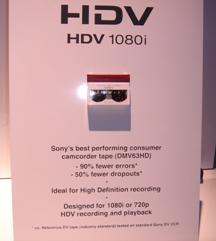 HDV was announced in the summer of 2003 and was established as an official format in the fall of 2003. Canon, JVC, Sharp, and Sony are the primary manufacturers supporting this HD format that uses mini-DV videotape, MPEG-2 and at resolutions of 1080i and 720p. The companies indicated that camcorders could be made that can record on the same mini-DV both regular and HD formats.
Ikegami
Sep 04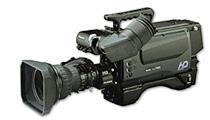 HDK-75EX digital HDTV camera system, 12-bit A/D conversion digitizing video signals, 39-bit internal digital processing circuit, performs digitally non-linear processing (such as gamma correction), 4.5 Kg with fiber adaptor excluding lens, only 28w of power consumption, 1000 TV lines of horizontal resolution, next generation 0.18 micro m ASICs in the new CCU-790A Camera Control Unit, frame multi-format conversion for 24p, 30p, 50p, 720p, 1080i, 480i, etc. http://www.ikegami.com/br/products/hdtv/hdk75ex.html
JVC
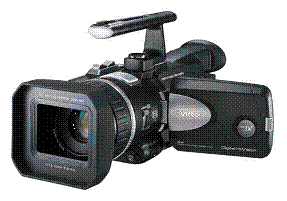
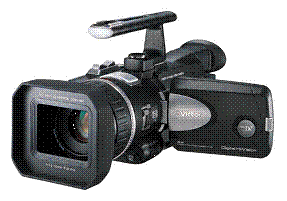 The current model for 720p (on the right) was included in the CES 2003 Report GR-HD 1, TTM March 2003, MSRP estimated at around $3,000, records in Mini DV tape at native 720/30p, 480/60p, and 480i, plays back 1080i, 720p, 480p, and 480i.
In April 2004, the company announced a prototype of a H/DTV video professional-grade camcorder using three 2/3-inch CMOS imager chips of 1920x1080 each adaptable to 720p and 1080i, and with an MPEG-2 encoder, capable of progressive 24fps HD, and utilizing the new HDV recording format for 276 minutes on full size DV media, and up to 60 minutes on mini-DV media.
The current model for 720p (on the right) was included in the CES 2003 Report GR-HD 1, TTM March 2003, MSRP estimated at around $3,000, records in Mini DV tape at native 720/30p, 480/60p, and 480i, plays back 1080i, 720p, 480p, and 480i.
In April 2004, the company announced a prototype of a H/DTV video professional-grade camcorder using three 2/3-inch CMOS imager chips of 1920x1080 each adaptable to 720p and 1080i, and with an MPEG-2 encoder, capable of progressive 24fps HD, and utilizing the new HDV recording format for 276 minutes on full size DV media, and up to 60 minutes on mini-DV media.
Sony
On April 2004, Sony announced that it would introduce at NAB 2004 a HDV based camera for US consumers that was demo at the CeBIT 2004 IT and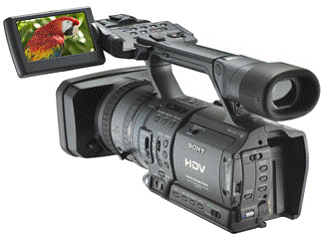 telecommunications show in Hanover, Germany. Later in September the camera was released as the HDR-FX1, a 3 1/3-inch 16:9 1.12 Megapixel gross CCDs, HDV Camcorder, each CCD of 960x1080 oblong pixels for 16x9, 1080i, MPEG-2, uses standard MiniDV tapes, Carl-Zeiss lens, zoom ring, focus ring, iris /aperture ring, manual controls, $3700 MSRP expected to sell at around $3400, upgrade options from hi-end Sony cameras are offered.
On November 2004, Sony 's Business Solutions & Systems Group introduced the HVR-Z1 HDV Camcorder, $4900, TTM Feb 05, similar CCD optical-block as the HDR-FX1 above, with three 1/3-inch Super HAD 16:9 CCDs, each CCD has 1.2 megapixels in a 960x1080 matrix, and due to offsetting the green CCD one-half element spacing from the red and blue CCDs, attain additional luminance which increases the horizontal resolution 150%, obtaining a resolution of 1440x1080 encoded as MLMP-14 MPEG-2. A version of the camera would be for Region 60 (1080i/60 and 4:3, 16:9 NTSC PAL DV), and another for Region 50 for 1080i/50 and 4:3, 16:9 PAL DV. 3.5-inch LCD viewfinder with 250,800 pixels. http://news.sel.sony.com/pressrelease/5331
Also, Sony Media Software announced Cineform's Connect HD application software for Vegas 5 editing software users at a promotional price of $150, which improves the HDV editing capabilities within Vegas by capturing and export HDV images between the HVR-Z1U and other HDV cameras.
Back in September 2004, Ulead Systems announced their plans to support the Sony HDR-FX1 with cost-effective HD video editing within MediaStudio Pro, their professional software suite.
Be sure that you read the next article in the series: HDTV IC Chips (Coming Soon)
telecommunications show in Hanover, Germany. Later in September the camera was released as the HDR-FX1, a 3 1/3-inch 16:9 1.12 Megapixel gross CCDs, HDV Camcorder, each CCD of 960x1080 oblong pixels for 16x9, 1080i, MPEG-2, uses standard MiniDV tapes, Carl-Zeiss lens, zoom ring, focus ring, iris /aperture ring, manual controls, $3700 MSRP expected to sell at around $3400, upgrade options from hi-end Sony cameras are offered.
On November 2004, Sony 's Business Solutions & Systems Group introduced the HVR-Z1 HDV Camcorder, $4900, TTM Feb 05, similar CCD optical-block as the HDR-FX1 above, with three 1/3-inch Super HAD 16:9 CCDs, each CCD has 1.2 megapixels in a 960x1080 matrix, and due to offsetting the green CCD one-half element spacing from the red and blue CCDs, attain additional luminance which increases the horizontal resolution 150%, obtaining a resolution of 1440x1080 encoded as MLMP-14 MPEG-2. A version of the camera would be for Region 60 (1080i/60 and 4:3, 16:9 NTSC PAL DV), and another for Region 50 for 1080i/50 and 4:3, 16:9 PAL DV. 3.5-inch LCD viewfinder with 250,800 pixels. http://news.sel.sony.com/pressrelease/5331
Also, Sony Media Software announced Cineform's Connect HD application software for Vegas 5 editing software users at a promotional price of $150, which improves the HDV editing capabilities within Vegas by capturing and export HDV images between the HVR-Z1U and other HDV cameras.
Back in September 2004, Ulead Systems announced their plans to support the Sony HDR-FX1 with cost-effective HD video editing within MediaStudio Pro, their professional software suite.
Be sure that you read the next article in the series: HDTV IC Chips (Coming Soon)