
3DTV Going South
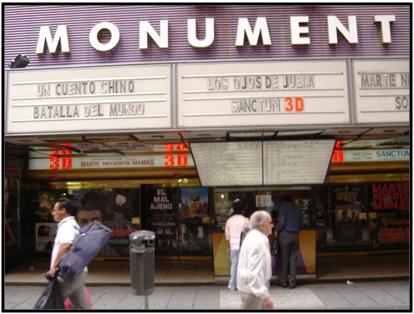
The 3D naysayers may reschedule the party, I meant geographically "south", way south.
I am in Buenos Aires, Argentina this week, eating as much of the famous tender beef my stomach can take, for which I had to reset myself to my young years of dining after 9:30pm and having desert at 2am after the second bottle of great red wine in a restaurant that is still full of people. In other words, like Paris in South America.
 The night life and streets are packed with people having a good time. It is difficult walking a straight line on these busy streets, and the second bottle of red wine had nothing to do with it. The energy in the air feels like the non-stop busy avenues of NYC.
On my visit I met again with Mr. Victor Acuña, the HDTV engineer that joined me on the articles about "DTV around the world". We discussed the DTV implementation and his testing in Argentina. I left Buenos Aires 36 years ago as a Systems Analyst, and now I come back every year as an HDTV professional, all under the common denominator of the digital world, the magic of ones and zeros, now also applicable to 3DTV.
We discussed the status of the DTV transition, his testing experiences in terrestrial and mobile DTV, the politics of who implemented what of DTV in which country and why, and exchanged lots of technical data. But I also used the opportunity to look around the city for technology introductions about HDTV and particularly 3DTV.
I wanted to get an idea of what kind of information sales people give to consumers about HDTVs and 3DTVs. As we experienced in the U.S. over the past decade, HDTV sales staff show the same authority as when they sell refrigerators and dishwashers to the next customer, conveying a "know-it-all" appearance even about the most complex TV subjects. As it happened in the U.S. unsuspected consumers received inaccurate information from untrained sales personnel, and regarding 3DTV the situation is even worse.
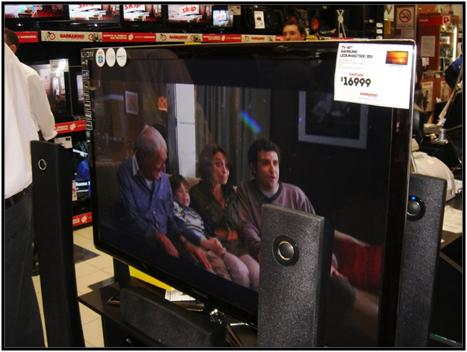 As I write this article, 3D movies/theaters and 3DTVs and 3D Blu-ray players with discs are shown at most electronics stores However, no 3D demonstrations took place during any of my visits. One main manufacturer offering 3DTV packages is Samsung, a 46" LCD/LED 3DTV with a 3D Blu-ray player and one active-shutter glasses pair selling for about $5,500 U.S. dollars ($22,000+ in local currency). The 3DTV itself was offered by another store for $4,250 U.S. dollars ($16,999 in local currency), which is about 3 times the price Amazon sells the 3DTV in the U.S. (UN46C7000).
There was no way to get additional active-shutter 3D glasses in any of the stores I visited, but the recommendation generally was: you can buy the extra glasses online for about $180 a piece. In other words "you are on your own". The only way to get 3D glasses at retail stores is by buying a 3DTV package, like Samsung.
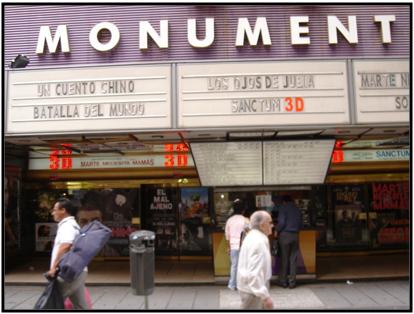 What was interesting is that while 3D content and 3DTVs are already in stores, over-the-air HDTV (ISDB-T, based on the Japanese standard) is still going thru testing of terrestrial and mobile reception at various locations. A relatively small number of set-top-box adapters for legacy analog TVs were distributed free to low income people (I was said approximately 300,000 from the planned 1 million), which would allow them to receive a small group of digital channels with predominantly pro-government political content. In a way this is a life-saver, considering that now cable content is scrambled and cannot be stolen as easy. In other words, a DTV transition has become a good tool to get votes from those that are relatively easy to convince.
The TV panels at the stores (primarily LCD, some with LED) and the Blu-ray pre-recorded media both show 1080p quality. Some TVs even show 3D with active shutter-glasses. Interestingly enough this is the reverse of what happened in the US: HDTV was implemented in 1998, Blu-ray was in 2006, and 3DTV and 3D Blu-ray were later in 2010.
Multi-frame-rate LCD 1080p TVs are able to display 1080p60fs Blu-rays and also able to display 1080i50fps HDTV from cable, satellite, and over-the-air (when fully implemented).
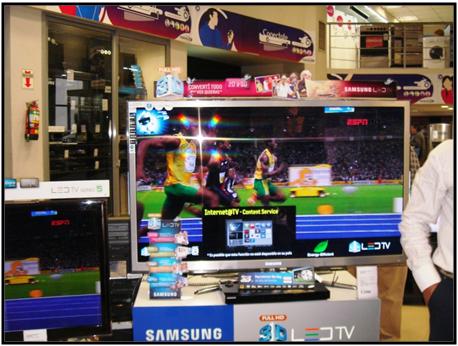 The digital tuners of most DTVs sold until recently are not compatible with the new digital broadcast system, but new DTVs are coming with compatible over-the-air digital tuners, and set-top-boxes are made available for previously purchased DTVs (with useless digital tuners).
Some Blu-ray players can not only play Region 4 Blu-ray discs but also play US's region 1 discs. Discs from both regions playback at 1080p 60fps and can be viewed via HDMI. The same should apply to the 3D versions. The component analog connections are limited as 1080i (as with the US).
As mentioned, most of the TV panels on sale are LCDs, although some CRTs are still selling. As with the US many LCDs are incorrectly advertised as LED sets, as if they would be different televisions, rather than indicating that LED is only a different light source of an LCD panel. Plasma was invisible in the stores, so consumers have no way to compare image quality, other than seeing that LCD X looses considerable contrast and color intensity when viewing it at 20% off center while LCD Z does it at 30% of center.
After a whole day visiting electronic stores I met only one sales person that was actually knowledgeable about HDTV and knew enough of 3D to be helpful to consumers, rather than the dangerous standard of sales staff.
He even mentioned the soon to be available passive type of 3DTVs, but without telling him who I was, his eyes were wide open when I mentioned the fact that those 3DTVs show 3D at only half-resolution per eye, and his eyes opened more when I explained how a side-by-side 3D program displayed on a passive 3DTV theoretically drops 75% of the original resolution.
He should be now ready to inform consumers properly when those passive 3DTVs arrive at the stores in Buenos Aires maybe next year. Although his knowledge may help him become store manager eventually, consumers rather need him as a sales staff trainer.
In summary, while 3DTV and 3D content is available in Buenos Aires at most consumer electronic stores, the terrestrial and mobile HDTV is still in testing phase and is facing digital TV tuners incompatibility. The "horses behind the carriage" scenario compared to the U.S. Actually, as a movie fan, I would have loved to have Blu-ray, 3D Blu-ray, and 3D/HDTV panels introduced in the U.S. before terrestrial HDTV was implemented in 1998.