Rodolfo La Maestra

Rodolfo La Maestra

Senior Technical Director

Rodolfo La Maestra is the Senior Technical Director at HDTV Magazine and participated in the HDTV vision since the late 1980's. In the late 1990's, he began tracking all HDTV consumer equipment, and since 2002 he authors the annual HDTV Technology Review report covering HDTVs, Hi-def DVD, content providers, broadcast, cable, satellite, government, standards, connectivity, content protection, H/DTV tuners and DVRs, etc. In addition Rodolfo has authored a variety of tutorials, books, and educative articles for HDTV Magazine, DVDetc, and HDTVetc Magazines, Veritas et Visus Newsletter, Display Search, and served as technical consultant/editor for the "Reference Guide" and the "HDTV Glossary of Terms" for HDTVetc and HDTV Magazines. In 2004, he began recording a weekly HDTV technology program for MD Cable television, which by 2006 reached the rating of second most viewed by the public, here is the opening episode.

Rodolfo's background encompasses Electronic Engineering, Computer Science, and Audio and Video Electronics, over 4,700 hours of professional training, a BS in Computer and Information Systems, and over thirty professional and post-graduate certifications, some from American, George Washington, and MIT Universities. Rodolfo was also Computer Science professor for over 700 students in five institutions between 1966-1973 in Argentina, for IBM, Burroughs, and Honeywell mainframes. After 38 years of computer systems career, Rodolfo retired in 2003 as Chief of Systems Development from the Inter-American Development Bank where he directed 65 software-development computer professionals, supporting member countries in north/central/south America 24x7.

In parallel, from 1998 he helped the public with his other career of audio/video electronics. Rodolfo started with hi-end audio in the early 60’s and merged with Home Theater video, multichannel audio, widescreen laser disc, anamorphic DVD, 16x9 NTSC displays, HDTV, Hi-def DVD, IPTV, HDMI, and 2.35:1 Cinemascope HD Home Theater over the past 40+ years.

When HDTV started airing in November 1998, he was an early adopter of HDTV and realized that the technology as implemented would overwhelm regular consumers due to its complexity, and it certainly does even today. Rodolfo then launched his HDTV mission of educating and helping consumers understand the complexity, the challenge, and the beauty of the technology, so the public learns to appreciate HDTV not just as another television.


133 Articles3 Reviews1 BulletinsRSS

Articles by Rodolfo La Maestra

Living with 4K - Bought an UHDTV? wait, is it Upgradeable?

Early UHDTV adopters face potential obsolescence as the ITU Rec. 2020 standard introduces features beyond 4K pixel resolution, including 10/12-bit color depth, 4:2:2 and 4:4:4 chroma subsampling, HDCP 2.2 content protection, and HDMI 2.0 support for 4K at 60fps - capabilities many current displays cannot handle. Most manufacturers offer no upgrade path, while Samsung's replaceable connectivity box and Sony's in-home hardware upgrades for models like the $25,000 VW-1000 projector represent notable exceptions. Buyers should carefully evaluate upgrade commitments before purchasing, as connectivity gaps similar to the HDTV-to-HDMI transition of 1998-2003 could strand millions of early adopters again.

Articles
Living with 4K - Nuvola 4K Player NP-1

Living with 4K - Nuvola 4K Player NP-1

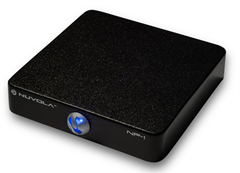
The Nuvola NP-1 is a $299 4K media player powered by an NVIDIA Tegra 4 quad-core processor with 72 GPU cores, running Android 4.2 and featuring a single HDMI 1.4 output limited to 4:2:0 chroma subsampling at 8-bit depth and 24/30 fps. It supports H.264-based 4K streaming and local playback via USB 3.0 storage, with H.265/HEVC support promised via firmware update, but its single-HDMI design forces buyers to use an HDMI splitter or sacrifice multichannel audio. Compared to Sony's $699 FMP-X1, the NP-1 offers broader TV compatibility and lower cost, though its video and audio connectivity limitations have real consequences for home theater installations.

Articles
Kaleidescape Cinema One - Review

Kaleidescape Cinema One - Review

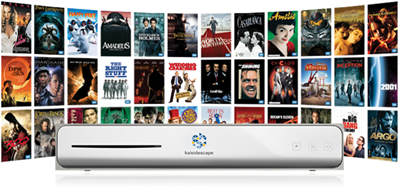
The Kaleidescape Cinema One is a 4TB media server priced at $3,995, capable of storing up to 100 Blu-ray-quality or 600 DVD-quality movies, with bitstream pass-through of Dolby TrueHD and DTS-HD Master Audio over HDMI. Testing against an Oppo reference player in a high-end home theater revealed that a default-enabled detail enhancement setting degraded image quality when used alongside a Darblet video processor, and AACS licensing requires the physical Blu-ray disc to be present during playback of imported titles unless a $3,995 DV700 vault is added. Factoring in hardware amortization, per-movie cost-of-ownership for Blu-ray collectors ranges from roughly $60 to $105 depending on system configuration, making the value proposition heavily dependent on collection size and usage pattern.

Articles
Living with 4K - Here is the 4K Content

Living with 4K - Here is the 4K Content

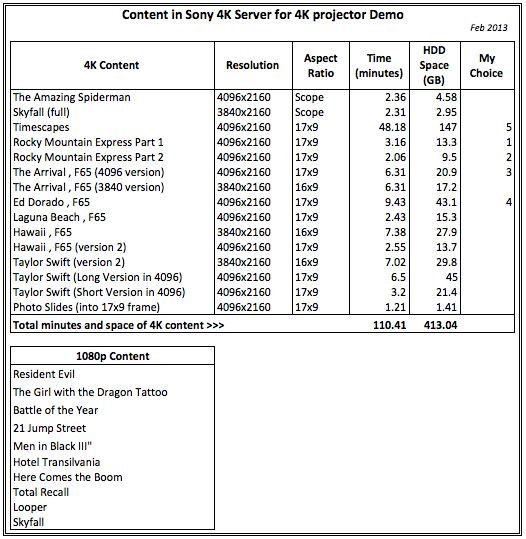
Sony's 4K demo server for projector owners is an HP-based system delivering up to 2 hours of 4K content, including the 48-minute TimeScapes nature film, connected via hi-speed HDMI with only stereo or Dolby 5.1 audio tracks via Toslink. Content is encoded at 8-bit, 4:2:0, Rec-709 color space at 24fps, the same baseline as Blu-ray, leaving the full potential of 4K unrealized in many clips. Viewers evaluating on a 130-inch Stewart Firehawk screen found that well-shot material like the Rocky Mountain Express clips delivered a convincing sense of realism, but inconsistent lighting and compression in other clips made some 4K content indistinguishable from 1080p Blu-ray.

Articles
SmartStick Makes "Any" TV Smart

SmartStick Makes "Any" TV Smart

The Favi Entertainment SmartStick is a $49.99 Android 4.0 HDMI dongle featuring an ARM Cortex-A9 at 1.0 GHz, 1GB DDR3 RAM, and 802.11 b/g/n Wi-Fi, designed to add Netflix, YouTube, browsing, and email to existing displays. Testing revealed persistent Wi-Fi instability even on a 100Mbps fiber connection clocking 57Mbps at the router, a non-functional remote, and output limited to 720p and 1080p, excluding the estimated 124 million US TVs lacking HDMI or requiring 480i/1080i signals. Buyers should verify HDMI and resolution compatibility with their specific TV before purchasing, and confirm a flexible return policy given the erratic real-world performance documented here.

Reviews