
WABC, Cablevision Kiss and Make Up. Who’s Next?
Disney-owned TV station WABC made good on its threat early Sunday morning to pull its signal from Cablevision systems in New York and northern New Jersey after a dispute over retransmission fees could not be resolved amicably. But the two companies reached an agreement about 15 minutes into the Oscars telecast, restoring the signal just as the nominees for Best Supporting Actor were announced.
According to several published news reports, WABC was seeking a fee of $1 per subscriber, whereas Cablevision was countering with 25 cents per sub. Supposedly, the companies arrived at a figure in the range of 60 cents per sub, although that can’t be confirmed right now.
In a similar battle last December, the Fox network duked it out with Time-Warner, asking for $1 per sub but reportedly getting about half that in the final negotiations. It’s expected that Disney (the owner of ABC and ESPN) will play even harder ball against Time Warner in August, when those cable carriage agreements come up for renewal.
The timing couldn’t be worse for Cablevision subscribers, what with the Academy Awards telecast on Sunday. But it didn’t mean all was lost – it just meant folks would have to try and pull in the signal on channel 7 using an old-fashioned antenna.
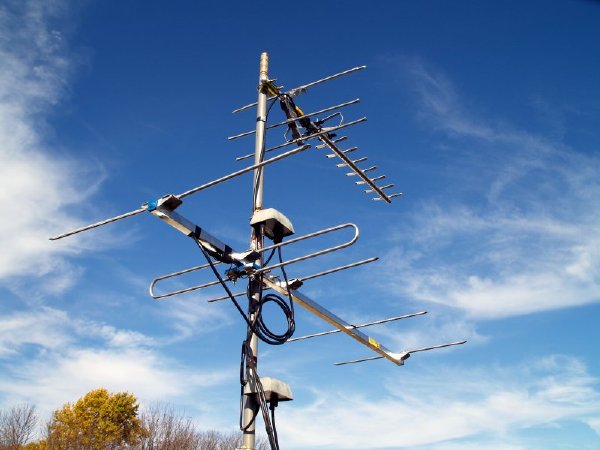
WABC’s signal is quite strong down here in Bucks County, PA and I can receive it with a five-element VHF yagi plus a mast-mounted preamplifier, mounted about five feet above my roof . The straight-line path from here to the Empire State Building is about 65 miles, and there are two ranges of hills in the way.
Here's my rooftop antenna system, aimed at New York City. The lower antenna does a great job pulling in WABC-7.
So I’d expect almost anyone who is 30 miles or less from Empire with a reasonably clear path will be able to pull in WABC’s HD signal, using an outside antenna. Within 15 miles, you may only need an indoor antenna, preferably one that can be rotated and has a switchable amplifier built-in.
Get used to these retransmission fee disputes – you’re going to hear more about them with each passing year, as TV stations move away from the old “must carry” system – where a local station had to be carried on the cable system, but received no money for that carriage – to retransmission agreements, which place a value of the TV station’s content.
Traditional TV networks are realizing their programs are worth just as much (if not more) than that offered by cable nets like USA, TBS, and TNT. And with advertising revenue down, thanks to the recession, those per-subscriber fees are becoming vitally important.