
HDTV Expert - Smart Watches Have Not Excited Consumers - But They're About To
Smart-watch makers are trying to find the right combination of design, functionality, interface, and price that will galvanize a customer population that is curious, but not yet motivated to open their wallets in large numbers. Probably the best-selling smart watch is Samsungs first-generation Galaxy Gear, which Samsung says sold about a million units through the first quarter of this year despite a $299 price and generally unfavorable reviews. Supply-chain analyst David Barnes (db@bizwitz.com) has told me privately that he is skeptical and believes that if Samsung made a million Gears, at least half of them are sitting in warehouses.
The second-generation Gears (there are versions with and without a camera, and for both the Galaxy moniker has been dropped) are have physical designs that is a bit more refined. Still, they look devices made made by a consumer electronics company, not by a watch company.
As Richard Windsor noted in a recent Radio Free Mobile newsletter, nearly all smart watches look like objects only a nerd could love. What is required for
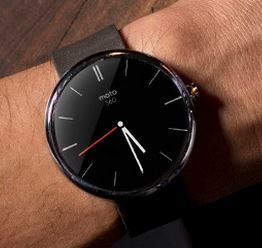
Motorola Mobilitys Moto 360 Smart Watch, here looking like a classically designed upscale watch. (Photo: Motorola Mobility)
major success is a product that looks like an attractive, upscale watch. Motorolas Moto 360, which is powered by Google's new Android Wear OS, could be such a watch. And Motorola Mobility, still under Googles managerial hand, spent a lot of time and effort on the physical design of the product, including the design of the images displayed. If the price is about right, which I would judge to be $250 or less, this could be a breakout product. Motorola says the watch is coming this summer in a selection of styles.
It is encouraging that watch and fashion company Fossil is also working with Google and is likely to be producing watches incorporating Android Wear later this year.
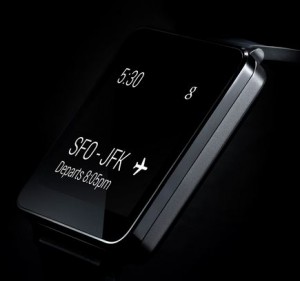
LG and Samsung are also on board with Android Wear, and the LG G smart watch is getting high-level support. “The opportunity to work with Google on LG G Watch was the perfect chance for LG to really pull out all stops in both design and engineering,? said Dr. Jong-seok Park, president and CEO of LG Electronics Mobile Communications Co., in a March 19 press release. Photographs of a prototype show a rectangular, plastic-bodied watch in consumer-electronics-company rather than watch-maker style. Theres plenty of time for that to change, though, since LG is saying further details will be released over a period of months.
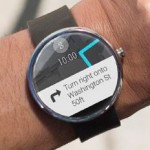
Moto 360 with turn-by-turn directions on a now smart-watch-looking screen. (Photo: Motorola Mobility)
The baseline performance of newly designed smart watches will be established by Android Wear. A highly polished iWatch with a great UI could be a formidable competitor, but in Apples post-Steve Jobs era, there is less confidence that the company can pull off anything better than what its competitors are already developing. And, despite the endless rumors, Apple has made no iWatch announcements.
If, as is very possible, Android Wear becomes to watches what Windows once was (and to a significant degree still is) to PCs, Google will command the attention of application developers and chipmakers, which will make it even more difficult for others to establish other watch OSs that will take significant market share. In this context, it will be interesting to see if Samsung abandons the Tizen OS for its third Gear generation.
The confined spaces and small battery size inherent in a smart-watch design obviously create interesting problems for the display and display sub-system designers. Motorola Mobility is seeming going with a round full-color LCD. The current generation of smart watches and prototypes use LCD, OLED, and Qualcomm mirasol. E Ink electrophoretic displays have been used successfully in

The LG G Smart Watch prototype, which looks like it was designed by a consumer electronics rather than a wristwatch company. (Photo: LG)
commercial watches made by Phosphor Watch and other companies, and have also appeared in smart-watch prototypes. Qualcomms Pixtronix MEMS
display technology, which I predict will soon eclipse the problematic mirasol, could also be a candidate. But the first commercial Pixtronix-based displays will be in a larger size.
Currently, the most exciting project for me is the Moto 360. For the larger market, Im very interested in seeing what
Fossil produces. And technically, the LG G might expand the envelope. This is a fascinating new industry, crying its birth cries as we watch.