
Looking for Consumer Electronics at CES
The Consumer Electronics Show 2015 was the biggest in history — again — but the show feels increasingly strange. For a show that is nominally about consumer electronic products, a surprising number are either not consumer products or not electronic.
A significant portion of Panasonic's booth was devoted to a men's grooming salon where male attendees were being barbered for free, with the barbers using Panasonic grooming devices. Not far away was a beauty salon, where female attendees were being beautified, again with Panasonic beauty products. I saw a beautician using a Panasonic hair dryer with great enthusiasm.
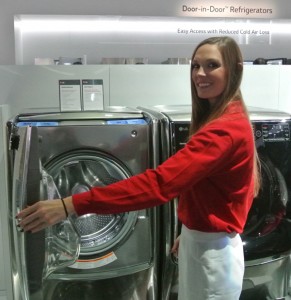
Samsung, LG, and others showed stoves, refrigerators, washing machines, and dryers. I mentioned to one LG representative that she reminded me of Betty Furness opening a refrigerator door in ancient TV commercials. The rep enthusiastically did her best Betty Furness imitation and opened the nearest appliance door, which belonged to a clothes dryer.
Panasonic also emphasized commercial products, including batteries, and promoted the huge battery plant it is building near Reno with Tesla Motors. Also in Panasonic's booth was the new Tesla Model X crossover SUV, which has a 0-60 acceleration time of 5 seconds.
Continuing the trend of several years, the Las Vegas Convention Center's North Hall looked more like an auto show than an automotive electronics show, which CEA claims it is. To be sure, most of the manufacturers were emphasizing electronic controls, navigation, or infotainment systems, but Toyota's large booth was devoted almost entirely to its new hydrogen fuel-cell-powered Mirai ("future" in Japanese). Don't get me wrong, Toyota's in-depth exhibit was fascinating, but where is the consumer electronics product?
Of course, there are still lots of consumer electronic products at CES. A major trend in TV this year is the increasing commoditization of UHD (4K) TV. The speed with which 4K has gone from expensive to cheap continues to surprise many people in the industry. If last year was the year of UHD-TV's breakout, this year will surely be the breakout year for quantum-dot-enhanced TV. Many major manufacturers announced QD-enhanced TVs for release this year, including Samsung, LG, and TCL. Unfortunately, they will probably be called "QD-TVs." But if we can survive "LED TV," we can probably survive "QD-TV", too.
Viewed side by side with conventional LCD-TVs, the increased color saturation and gamut produced by QDs provide an obvious improvement in image quality and allow TV makers to exceed 90% of REC.2020. Combined with 4K, QDs produce really compelling images. Samsung went so far as to say that QD enhancement provides image quality that is superior to OLED. Side-by-side comparisons in a quantum-dot maker's suite made a credible case for that. The OLED display had blacker blacks, but the QD-enhanced LCD was brighter and had a larger color gamut.
When LG announced their line of QD-enhanced TVs, its marketing people were forced to walk the top of a very narrow fence. They said the new QD-enhanced TVs offered a huge improvement over traditional LCDs, that the new sets are beautiful and that everybody should buy one — but the sets are not as good as OLED! That's a really tough balancing act to pull off.
This year QD will be for premium sets, with TCL saying they will have a UHD 65-inch with QD for $3000 later in the year. Next year, these sets will enter the pricing mainstream. Even I may be tempted to open my wallet.