
Does your LCD image look the same from an angled view? (Part 2 - The 3M Solution)
As mentioned in part 1 of this article, it has been known from the beginning of LCD, but not well informed by retailers to consumers, that LCD has an inherent viewing problem when the angle of view is off center, and depending on the LCD, the color, brightness, and contrast, drop considerably as the viewer moves from a center position (90 degree straight to the panel) to angles that are typical of the sitting arrangements of most family rooms, whereby viewers gather around the screen, and although they may still view an image, it is typically not of the same quality of the image perceived by the person viewing straight to the set.
This is more noticeable when the LCD is calibrated down from the torch mode stores like to show their TVs due to their ambient light, to a setting that would offer a more natural image at home to avoid seeing everything like a brilliant cartoon flashing at you.
This also means that because many of the LCDs at the store are demo at their extreme light output (to facilitate a sale) they may appear not to have a view-angle weakness when comparing them to others that show a natural image but are less striking than the torch mode LCD, but is the kind of image one should prefer at home after calibration, so a movie film actually looks like the film the director intended, not like a cartoon feature.
For years LCD companies have claimed that their sets can be viewed all the way to 170+ degrees. That number would be like viewing the panel all the way to the side, almost parallel to the edge of the TV frame. Have you actually tried to do that with your set? Do you still see the same image quality if any image at all? Is the image still appealing to you, or you rather move back to the center? Try moving gradually from the center passing the 20 degrees angle to the left or right and keep increasing the angle (20 degrees is about what your companion viewer may be seeing if sitting right by your side). This report (Viewing Angles section) covers more detail about the subject.
Companies like Panasonic, Sharp and others have implemented new technologies that claim view-angle improvement on their sets, but one company have created a product that could be used by all manufacturers that would like to adopt it, that company is 3M. 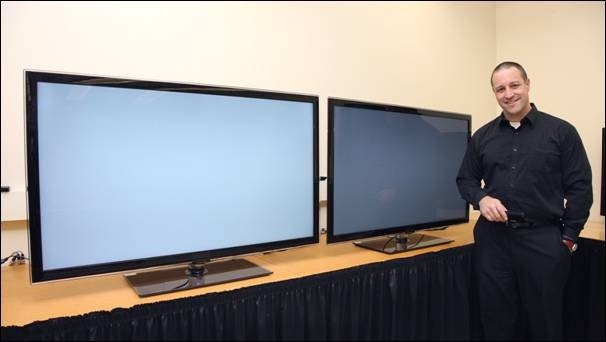
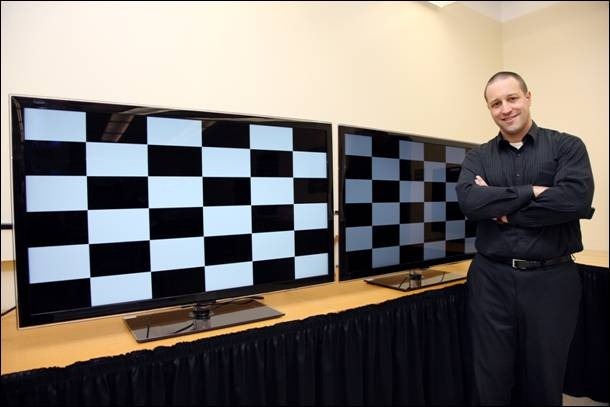
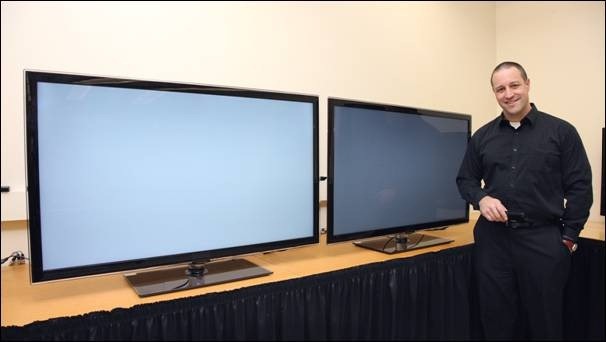
3M Physicist Dr. Dave Lamb stands next to 2 LCD TV screens with identical on-axis brightness, but varying degrees of wide-angle luminance - a combination of off-axis viewing and brightness. Some LCD TVs lose quality when viewed from the side, such as the TV on the right. Photos credit: 3M.
After the demo I was invited at CES 2012 showing the above comparison I asked Dr. Dave Lamb to provide more technical details about how exactly their product works to improve so well the angle of view. He offered the following graph and explanation:
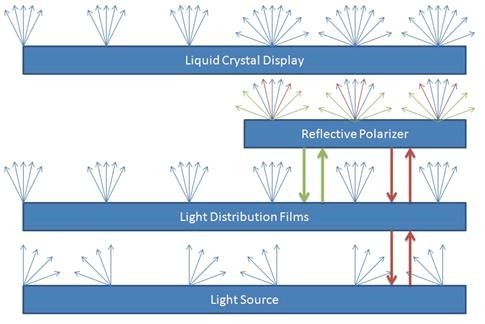
And I quote (in italic) his explanation as follows:
“Three backlight components are shown and the LCD. Starting from bottom to top, we have:
1) Light Source. This box can represent an array of direct-view LEDs or lamps or the light guide plate in an edge-lit configuration. The purpose of the light source is to generate light for the panel and to very roughly distribute it spatially and angularly. The output of the light source (as I've defined it here) is spatially and angularly non-uniform (as I've tried to indicate in the cartoon with the blue light rays being emitted by the light source).
2) Light Distribution Films. This box can represent the various combinations of diffuser, prism, and microlens films that are used to shape and make uniform the output of the light source. The output from the Light Distribution Films is spatially uniform, and it is typically collimated to some degree, meaning the light is contained within a cone. The shape or size of the cone is entirely defined by the combination of Light Distribution Films.
3) Reflective Polarizer. This box can represent 3M's DBEF and APF families of products. I am trying to represent several things with this film. First, some of the light from the Light Distribution Films is transmitted directly through the Reflective Polarizer (blue arrows). These blue arrows are within the same cone as that which comes from the Light Distribution Films. Second, some light of the wrong polarization is reflected by the Reflective Polarizer and interacts with one or more of the Light Distribution Films before being reflect back toward the Reflective Polarizer (thick green arrows). This is the light that has a chance to emerge from the Reflective Polarizer at broader angles than the cone defined by the Light Distribution Films. Third, there is a portion of light reflected by the Reflective Polarizer which makes it all the way back to the light source before being reflected back toward the panel (thick red arrows). This light emerges from the reflective polarizer within the cone defined by Light Distribution Films.
4) Liquid Crystal Display. This box can represent the LCD. As you know, the LCD selectively absorbs and transmits light from the backlight to form a visible image on the display. The light distribution cones transmitted through the LCD are similar to those incident on the LCD. Hence, the side with the Reflective Polarizer has more light at steeper angles, and the wide-angle luminance is enhanced (in addition to the axial luminance).
The next part (3) of this article series will cover and exchange I had with Dr. David Lamb regarding the suitability of the technology depending on panel cost, size, lighting style (edge, top, multi-zone), light dispersion effect on contrast ratio, possible reduction of the gained light due to the two extra layers between the light source and the LCD (if any), etc.
I hope this technology, or any other that could be as effective, could be implemented by LCD manufacturers across the industry. With the soon to be available OLED it appears that plasma technology panels would eventually be replaced as the current bastion of image quality when OLED pricing becomes accessible to consumers in the near future, hopefully as accessible as plasma is today.
LCD may continue as alternative panel technology even though it could not compete with OLED's image quality, but may still be attractive to the requirements of many consumers that may also benefit with (and need) the angle-of-view improvement brought by this 3M technology.
I wish the best to 3M on this effort, and I personally thank Dr. David Lamb for the demo, and for his collaboration on this article to educate our readers.