
3M Wants to Expand Market for DBEF Reflective Polarizer
During CES 2012, 3M's Optical Systems Division set up a demonstration in the Sony Theater at the MGM Grand. Dave Lamb (Senior Physics Research Specialist) and Dave Iverson (Business Manager, LCD Television Business) discussed a consumer study sponsored by 3M and conducted by CBS Vision that bolstered 3M's contention that using the company's Vikuiti DBEF reflective polarizer film is a significant value add for TV brands.
The results of the study had been announced a few weeks previously, but in Las Vegas I could experience the experimental set-up and explore some aspects not covered in the press release.
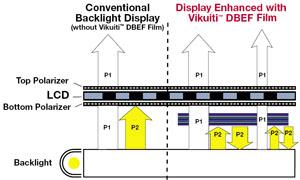
First, let's back up. What is DBEF, and what does it do? In a conventional backlit LCD display, only half the light from the backlight passes through the bottom absorbing polarizer. It is only this light, which is polarized in the proper direction to make it through the bottom polarizer, that can be processed by the LCD pixels to make an image. So, before the display can do anything useful with the light, we are throwing half of it away.
3M's Dual Brightness Enhancing Film (DBEF) is a reflective polarizer film that reflects light of the “wrong polarization instead of absorbing it. When the light bounces around after being reflected, its polarization is randomized by its reflections, so some of this light can now pass through the DBEF film. Ultimately, most of the light that originally had the “wrong polarization, makes it through the DBEF. Since the polarization axis of the DBEF is aligned with the axis of the bottom polarizer, most of this light passes through the bottom polarizer. (Not all of the light passes through, because the bottom polarizer is not 100% transparent even for light of the correct polarization.) Measurements have shown that DBEF displays are 32% brighter than displays without DBEF.
So, how was this perceived by subjects in the CBS Visual study? In the study, viewers were placed mid-way between two TV sets, each viewed at a 45-degree angle. One TV set had a DBEF reflective polarizer in the optical stack, the other had only the standard absorptive polarizer. Although there was more light in the viewing cone, the DBEF set used 15% less power.
When I sat where the test subjects had been seated, the DBEF set was clearly brighter. Lamb said that 88% of test group agreed with me, and that 83% of males and 64% of females 55 years old and older said they would pay an average of $200 for such a set.
Among the test group 46% said they typically watched their TV set at a viewing angle more than 15 degrees from dead center even when viewing alone. That number jumped to 67% for viewing with other people.
Lamb told me 3M has characterized roughly 150 TV sets since 2007-08. The typical luminance was 500 nits in 2008; it is 300 nits now. Energy Star is a major reason for the shift. But 500 nits was overkill at the time, motivated my luminance being a point of differentiation at a time when LCD-TV was still battling with both CRT and plasma for dominance. But now, Lamb said, TV manufacturers may be pushing the lower limit of luminance in pursuit of additional energy savings. How dim is too dim?
Clearly, 3M would like to convince TV manufacturers that DBEF is the solution to this conundrum for a wider range of models. DBEF is currently used in many high-end sets (including “a preponderance of Sony sets), but 3M is hoping that with more awareness of users wanting higher viewing angle and more brightness in addition to low power, TV makers will respond.