Digital Cinema

Living with 4K (Part 4) - Which 4K ... DCI 4K, Ultra-HDTV, Ultra-HD, Quad-Full-HD?

Living with 4K (Part 4) - Which 4K ... DCI 4K, Ultra-HDTV, Ultra-HD, Quad-Full-HD?

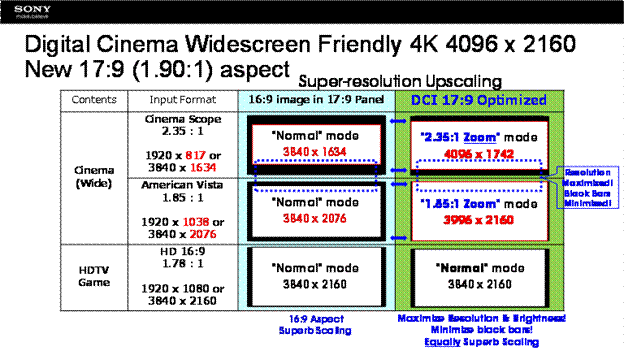
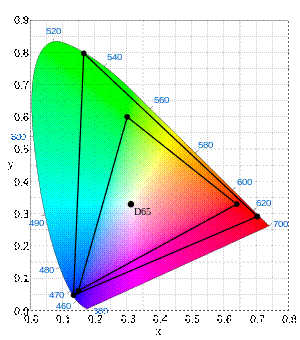
The DCI 4K standard, published in 2005 by seven major studios, defines a 4096x2160 resolution format using JPEG2000 encoding, 12-bit XYZ color space, and a maximum data rate of 250 Mbit/s, while the ITU-R BT.2020 UHDTV specification sets 3840x2160 and 7680x4320 resolutions with 10/12-bit quantization and up to 120fps progressive scan. These two competing standards use different pixel counts and color spaces, meaning a DCI 4K projector and a consumer Ultra-HDTV display are not interchangeable formats despite sharing the '4K' label. Understanding these distinctions is essential for anyone evaluating 4K display hardware or content pipelines.

Rodolfo La Maestra
Articles
Living with 4K (Part 3) - Which 4K ... DCI 4K, Ultra-HDTV, Ultra-HD, Quad-Full-HD?

Living with 4K (Part 3) - Which 4K ... DCI 4K, Ultra-HDTV, Ultra-HD, Quad-Full-HD?

The Sony VPL-VW1000ES home cinema projector ($25,000 MSRP) uses a true DCI 4K chip with 4096x2160 pixels (17:9 aspect ratio), distinguishing it from consumer Ultra-HDTV panels that offer only 3840x2160 (3.75K by binary measure). Standards bodies including DCI, EBU, ITU, and CEA each define 4K and Ultra-HD differently, creating a fragmented naming landscape that affects how buyers interpret product specifications. Understanding these distinctions matters practically when choosing between a cinema-grade projector and a 16:9 Ultra-HD panel for home use.

Rodolfo La Maestra
Articles

HDTV Almanac - Beyond Smell-o-Vision

CJ CGV's CGV Smartplex cinema deploys '4Dplex' technology across four operational venues in Korea, combining motion-synchronized seating, per-seat audio speakers, scent emitters, air blasters, and mist systems to create a fully immersive sensory experience. Stereoscopic 3D is layered on top of these physical effects, enabling real-time seat movement and localized sound cues tied directly to on-screen action. With a New York City installation planned, the technology raises the question of whether home theater systems will eventually follow the same multi-sensory path.

Alfred Poor
Columns

HDTV Almanac - The Fat Lady is About to Sing

The Metropolitan Opera's Live in HD program distributes live performances digitally to more than 1,200 movie theaters worldwide, eliminating the cost of physical film prints and selling over 2.2 million tickets in the 2009-2010 season alone. With six summer encores scheduled and nine live transmissions planned for 2010-2011, the model proves that digital cinema infrastructure can make niche content economically viable at scale. For exhibitors facing declining attendance, this approach offers a practical template for alternative programming beyond mainstream film releases.

Alfred Poor
Columns

Will 3D make actors redundant?

3D movies are rewriting Hollywood's box office rules, and actors may be losing their leverage. Effects-driven franchises like Transformers proved unknown leads can anchor billion-dollar hits, while Avatar, Alice in Wonderland, and How to Train Your Dragon demonstrate that 3D commands real ticket premiums customers willingly pay. As 3D Blu-ray releases loom on the horizon, the question isn't just about picture depth - it's about whether A-list star power still matters in a format that sells itself.

Pete Putman
column

Alice in 3D Land

Disney's Alice in Wonderland delivers a mixed 3D experience that reveals just how much projection technology matters. Shot in 2D and converted in post-production, the film's early live-action sequences feel largely flat through RealD glasses, while the vibrant Wonderland sequences gain momentum. A Sony 4K SXRD projector's weak black levels dulled contrast compared to Christie DLP presentations. Choosing the right theater could make the difference between a spectacular outing and a disappointing one.

Pete Putman
column

HDTV Almanac - DLP Wins Award from Academy

Texas Instruments DLP Cinema technology, deployed across more than 17,000 screens worldwide including 155 IMAX digital installations, earned four of its developers the 2009 Academy Scientific and Engineering Award for color accuracy. DLP's micro-mirror semiconductor design eliminates the need for polarized light, boosting light output and enabling passive-glasses 3D cinema displays. Beyond commercial cinema and home theater front projectors, miniaturized DLP imagers are now powering pico projectors small enough to embed in cell phones and portable media players.

Alfred Poor
Columns

Long Island Doctor Shows First '4K' Ultra-High Definition Surgery

Surgeon Steven Palter performed the world's first 4K laparoscopic surgery using the RED One camera system, which delivers 4,096 lines of resolution - four times that of standard HD - to produce the sharpest endoscopic images ever captured inside the human body. The footage was projected through a $200,000 Sony SRX-R220 projector and also converted into HD 3D surgical imagery using RealD and 3Ality systems. For surgeons and medical educators, this level of resolution and magnification could enable diagnostic detail far beyond what is visible during conventional laparoscopic procedures.

HDTV News
Bulletins

Hollywood Theaters to Install Sony 4K Digital Cinema Projectors Across Its Circuit

Hollywood Theaters is deploying Sony 4K digital cinema projectors across 167 screens at 13 U.S. locations, with the rollout including 53 screens configured for 3D projection using Sony's single-projector 3D lens system paired with RealD technology. Sony's 4K projectors deliver 8.8 million pixels, providing four times the resolution of 2K systems and exceeding consumer HDTV resolution. For moviegoers, this conversion means sharper, higher-contrast images in both 2D and 3D formats, while also enabling alternative content programming such as sports, music, and gaming events.

HDTV News
Bulletins

HDTV Almanac - Dots Enough Already?

JVC's Super Hi-Vision D-ILA projector delivers a staggering 7,680 by 4,320 pixel resolution using three LCOS imagers, equivalent to 16 tiled 1080p screens, at 60 Hz with 36-bit color depth requiring nearly 10 GB/s throughput. To handle that data load, JVC developed a four-channel fiber optic interface replacing the 16 coax connections that would otherwise be required. Powered by a 3,000-watt lamp producing 10,000 lumens and requiring 200V AC, this technology points toward the next frontier for digital cinema rather than home use.

Alfred Poor
Columns

HDTV Almanac - Really High-Def Cinemas

AMC Entertainment and Sony Electronics announced a joint initiative to convert all 4,628 screens across 309 North American theaters to Sony 4K digital projection systems, delivering 4,096 by 2,160 pixel resolution - four times the pixel count of standard 2K cinema displays (2,048 by 1,080). Sony Pictures Entertainment has committed to shooting most productions in 4K, with a full cinematography equipment line in development to support the format. For moviegoers, this resolution gap over home 1080p displays represents a concrete, near-term reason to choose the theater over an increasingly capable living room setup.

Alfred Poor
Columns

RealD Takes 3D Spotlight at CES

RealD demonstrated its stereoscopic Cinema System at CES 2009, powering a sneak preview of DreamWorks Animation's Monsters vs. Aliens and the first live 3D broadcast of the BCS college football championship game using Sony's SXRD 4K projector at the Paris Hotel and Casino. The company also showcased its home 3D solution, which delivers stereoscopic content to LCD, plasma, and DLP displays via existing high-definition infrastructure across more than 1,600 installations in 34 countries. Consumers and industry professionals can expect RealD's cinema-grade 3D technology to reach home displays without requiring costly new infrastructure.

HDTV News
Bulletins

Sony to Simulcast Live 3D Coverage of FedEx BCS Championship Game at CES and Theaters

Sony Electronics is partnering with FOX Sports, 3ality Digital, RealD, and Cinedigm to deliver the first live 3D simulcast of the FedEx BCS National Championship Game on January 8, 2009, using Sony's SXRD 4K projection technology with a pixel matrix exceeding 4,000 horizontal pixels - more than four times the resolution of standard HD. The production relies on Sony HD cameras modified for stereoscopic capture, 3ality Digital's self-correcting 3D image processing software, and Cinedigm's CineLive satellite distribution network reaching 80 digitally enabled theaters nationwide. Viewers at the Paris Hotel in Las Vegas during CES and at theaters across the country will experience live sports in immersive 3D, signaling a practical expansion of 3D broadcast beyond pre-recorded content.

HDTV News
Bulletins

DLP Cinema(R) Technology Surpasses 5,000 Screen Milestone

Texas Instruments DLP Cinema technology has reached 5,260 installed screens globally, representing a 140% increase year-over-year and commanding 99% of the digital cinema market across 42 countries. The single-projector platform supports both 2D and 3D presentations, with 300 additional units being fitted for 3D capability ahead of the Beowulf release, bringing U.S. 3D-equipped screens to 1,000. For exhibitors, this rapid deployment signals DLP Cinema as the de facto standard for digital projection reliability and format flexibility.

HDTV News
Bulletins

Ed's View - SHDTV (Part Duo)

The Digital Cinema Initiative (DCI) specification, established in 2002 by seven major studios, underpins a proposed Super High Definition Television (SHDTV) system targeting both theatrical and private home venues via satellite distribution. SHDTV operates at 4096x2160 pixels with a 250 Mbits/second compressed payload bit-rate, roughly 13 times that of standard ATSC HDTV, using lossless MJPEG 2000 compression and 48-bit per pixel color sampling. For consumers, this means a tightly controlled, non-mass-market home theater experience delivered through licensed installers under subscription or PPV models, positioned to augment rather than replace existing HDTV infrastructure.

Ed Milbourn
Articles