LED TVs

A New QLED Artifact

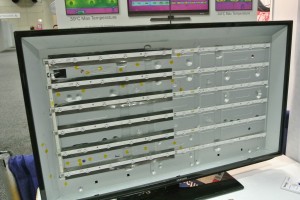
A visit to LG Display's Paju facility revealed a striking artifact in Samsung's Q Series QLED televisions - one previously unknown to seasoned display analysts. Edge-lit LCD panels using one-dimensional local area dimming produce a visible 'searchlight beam' or halation effect whenever bright objects share a dimming zone with darker surroundings. Full-array backlights could eliminate the problem, but marketing pressures favoring ultra-thin designs keep that solution off the table for now.

Ken Werner
Columns

Dolby Vision Will Soon Be Available in a Consumer TV Set

Dolby Vision is finally coming to consumer televisions, and VIZIO's Reference Series is leading the charge. The RS65-B2 pairs a 384-zone full-array LED backlight with quantum-dot technology, hitting 120% of DCI-P3 color gamut at a $5,999 price point that marks a genuine industry milestone. Immediate access to Warner Bros. and Netflix Ultra HD titles sweetens the deal considerably, and lower-cost Dolby Vision sets may not be far behind.

Ken Werner
Columns

The Amazing, Shrinking LED Pixel Pitch

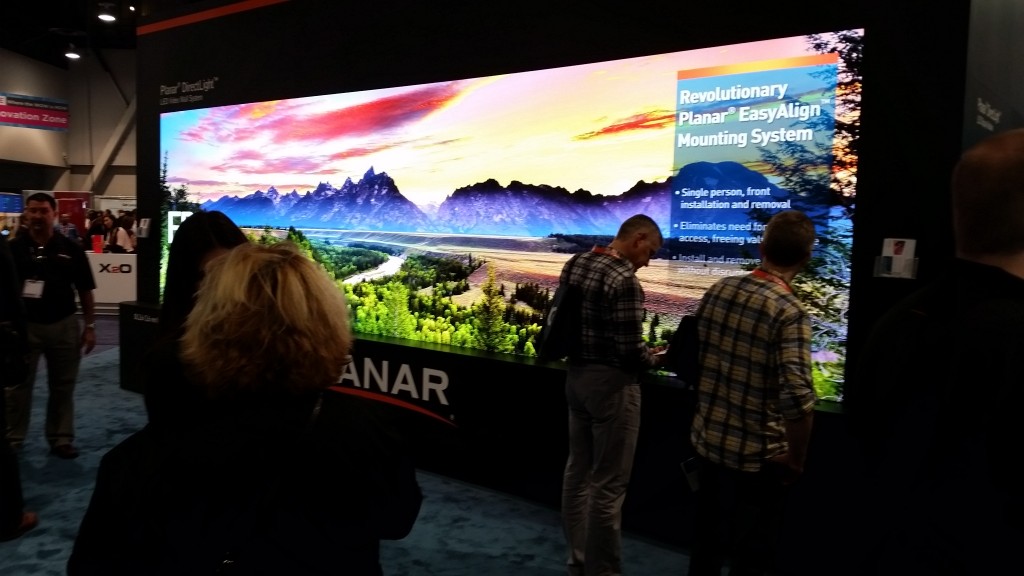
LED pixel pitch has shrunk from 12 mm to just 1.1 mm - matching early plasma TVs - opening signage to viewing distances far shorter than a football field. High-end retailers are already driving early demand for modular displays costing up to $6,000 per panel. Germany's InteGreat Project, coordinated by Osram Opto Semiconductors, is now targeting entirely new production paradigms that could push miniaturization - and market reach - even further.

Ken Werner
Bulletins

Best Buy’s Bharp TV: Turkey Most Foul

Sharp's deal to license its brand to Best Buy for a line of budget LED TVs raises serious questions about brand equity and retail strategy. Best Buy gains a tier-one label for low-end sets while Sharp risks devaluing the very name that commands premium prices. Sharp executive Jim Sanduski faces a near-impossible balancing act: protecting the Aquos brand, reassuring existing retail partners, and convincing shoppers that 'Bharp' TVs somehow outperform Best Buy's own Insignia house brand.

Ken Werner
Columns

Fat TVs Come Back

Thin TVs once defined premium design, but full-array LED backlights are pulling manufacturers back toward thicker builds - and for good reason. Local-area dimming, deeper blacks, and enhanced dynamic range deliver picture quality that edge-lit panels struggle to match. Vizio's 2014 M Series leads this shift with up to 36 dimming zones, while AmTRAN's budget JVC Emerald entry proves the technology scales across price points. Whether consumers embrace the extra depth depends on a question Sony's Tei Iki answered long ago.

Ken Werner
column

HDTV Expert - Two Words for InfoComm: LED and 4K

InfoComm 2013 showcased a rapid evolution in LED display technology, with pixel pitches reaching as low as 2.5mm and roadmaps targeting 1.0mm, a threshold that could make LED panels competitive with LCDs in large-scale applications. Sharp made a notable announcement with the immediate commercial availability of its 4Kx2K 32-inch professional monitor featuring an IGZO backplane, priced at $5,859 MSRP and targeting high-detail workflows such as financial trading and CAD-CAM. For display professionals, these developments signal a market shifting decisively toward higher pixel density and Ultra HD across both LED signage and flat-panel categories.

Ken Werner
Columns

HDTV and Home Theater Podcast - Podcast #584: Plasma vs LED

Plasma TVs deliver superior black levels, contrast ratios, and color saturation compared to LED LCD displays, with edge-lit LED panels frequently exhibiting backlight uniformity defects such as clouding, halo, and flashlight effects that are absent in plasma panels. Plasma's per-pixel brightness and hue control produces richer, more saturated color that mid-tier plasma sets match against higher-cost LED competitors, while In-Plane Switching (IPS) LEDs improve viewing angles only at the cost of contrast. For buyers prioritizing picture quality in a controlled-light environment under 65 inches, plasma remains the stronger value proposition despite its weight and image retention considerations.

The HT Guys
Podcasts

HDTV Expert - Lamp? What Lamp?

Lamp-free projection technology is emerging as a competitive response to large-format LCD displays, with manufacturers at Integrated Systems Europe 2013 showcasing LED and laser-based projectors ranging from 500 lumens to over 60,000 lumens for digital cinema. Sony debuted the first 3LCD laser imaging system, while Christie Digital demonstrated a 60,000-plus lumen laser DLP Cinema projector during a GI JOE: RETALIATION screening, and LED-only designs currently top out at 1,100 lumens with laser/LED hybrids bridging up to 4,000 lumens. For end users, lamp-free designs promise 15,000 to 20,000 hours of essentially maintenance-free operation with instant on/off capability, directly addressing the key advantages that large LCD panels hold over conventional projectors.

Pete Putman
Columns

HDTV Expert - ISE 2013: Oh, It's ON! - Pete Putman

At ISE 2013, Sony unveiled a prototype 3LCD laser projector rated at 4000 lumens with 1920x1200 (WUXGA) resolution, marking the first publicly demonstrated 3LCD design to use a 100% laser light engine. Mitsubishi countered with three LaserVue DLP models featuring hybrid red LED and blue laser diode illumination, promising 20,000 to 30,000 hours of rated lamp-free operation. These lampless projectors are a direct response to the growing commercial adoption of large-format LCD displays from 70 to 95 inches, which undercut projector installations on cost, maintenance, and ambient light performance.

Pete Putman
Columns

Sharp Introduces New Series of Ultra-Large LED Displays for the Large-Format Digital Signage Market

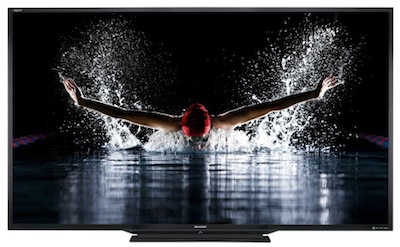
Sharp's new PN-R Series professional LED displays target indoor digital signage in 60", 70", and 90" class formats, with the flagship PN-R903 delivering a 1,000,000:1 contrast ratio via full-array LED backlighting with Local Dimming Technology and 700 cd/m2 brightness across all models. The 90" PN-R903 stands 6'8" tall in portrait orientation, making it capable of replacing a 2x2 46" panel video wall with significantly reduced wiring and calibration demands. Connectivity includes DisplayPort and an interface expansion board, while edge-lit variants suit LEED-compliant installations requiring lower energy consumption.

HDTV News
Bulletins

Sony Introduces OLED-like Color without OLEDs

Sony's Triluminos display technology, unveiled at CES without prior leaks, uses a quantum-dot backlight unit developed by QD Vision that employs a polymer prism strip with blue LEDs to produce narrow spectral emissions for red, green, and blue, dramatically expanding color gamut beyond what conventional white LED backlights achieve. QD Vision's approach differs from competitor Nanosys by keeping quantum dots in a high-heat-tolerant prism element positioned close to the LED strip, reducing material usage at the cost of modified BLU assembly. The result is an OLED-like color appearance on LCD panels, with Sony already pairing the technology with 4K resolution screens.

Ken Werner
Columns

HDTV Expert - CES 2013: From Hype to Ho-Hum in Minutes - by Pete Putman

CES 2013 showcased a flood of 4K Ultra HD TVs from virtually every major brand, with Chinese manufacturers like Hisense, TCL, and Haier matching Japanese and Korean rivals across panel sizes from 50 to 110 inches - all sourcing LCD glass from China Star Optoelectronics, a TCL-Samsung joint venture. IGZO semiconductor technology emerged as a key differentiator for Sharp, promising lower power consumption and faster pixel switching, while LG and Samsung debuted curved 55-inch OLED panels still unavailable for purchase. The practical takeaway is that rapid commoditization of 4K displays, driven by Chinese manufacturing scale, points toward significant price drops across all screen sizes by late 2013.

Pete Putman
Columns

NEC Display Solutions Introduces LED-Backlit Commercial-Grade LCD Displays to V Series

NEC Display Solutions has expanded its commercial-grade V Series with the 55-inch V552 and 65-inch V652 LED-backlit LCD displays, both featuring 1920x1080 full HD resolution, 4000:1 contrast ratio, and built-in 10-watt speakers. The Open Pluggable Specification (OPS)-compliant expansion slot allows internal routing of video, RS-232 control, and power to connected accessories, eliminating external cabling. TileMatrix support for video walls up to 10x10 and optional single board computer bundles make these displays a practical fit for retail, corporate, and digital signage deployments.

HDTV News
Bulletins

Toshiba Unveils 2013 TV Line-Up And PCS At Consumer Electronics Show

Toshiba's 2013 CES lineup centers on its L9300 Series 4K UltraHD LED TVs, powered by the CEVO 4K Quad+Dual Core Processor and available in 58-, 65-, and 84-inch class sizes, delivering four times the resolution of 1080p with built-in UltraHD upscaling and 2D-to-3D conversion. Premium LED models across the L7350, L7300, and L4300 Series add Cloud TV functionality with Intel WiDi and Miracast wireless display support. Consumers evaluating a connected home upgrade will find a broad range of screen sizes and price points, complemented by new Ultrabook convertibles and All-in-One PCs scheduled to ship from February 2013.

HDTV News
Bulletins
Brace Yourself: Sharp® Unveils Bigger, More Beautiful AQUOS® LED TV Lineup at CES 2013

Brace Yourself: Sharp® Unveils Bigger, More Beautiful AQUOS® LED TV Lineup at CES 2013

Sharp's 2013 AQUOS LED TV lineup, announced at CES, spans nearly twenty models in 60", 70", and 80" screen classes, headlined by the 90" world's largest LED TV at 141 pounds and under 5 inches deep. The new 8-Series introduces Quattron four-subpixel color technology delivering over one billion colors alongside a Super Bright panel rated 50 percent higher in brightness, while all three series include a dual-core smart TV platform with built-in Wi-Fi and HTML5 browsing. Buyers gain a broad range of large-screen options with active 3D, Bluetooth glasses, and Yamaha-powered 35W audio across multiple price tiers.

HDTV News
Bulletins