
articles
HDMI Part 3 - HDMI Version 1.3, Digital Connectivity at its Best
Lets us review the new features and what those would mean for your HD system.
 The foundation has been set for even higher bandwidths over a single-link. With double-link, if implemented, the 10.2 Gbps could virtually be doubled, if ever needed. How the possibility of several 1080p/60fps running simultaneously over HDMI for future applications sounds to you?
Eliminates color banding
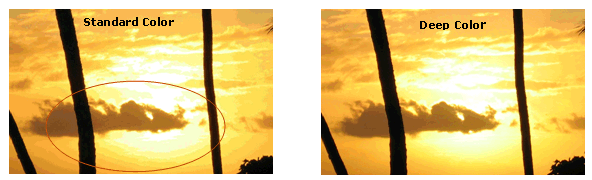
HDMI 1.3 allows displays to represent many times more shades of gray between black and white.
At 30-bit pixel depth, four times more shades of gray would be the minimum, and the typical improvement would be eight times or more.
Many devices cannot accurately represent many colors that exist in nature - leading to the sometimes cartoony look that you see on some displays. What is worse is that current display technologies, such as backlit LCD displays, can display colors far beyond those described by previously existing color space standards.
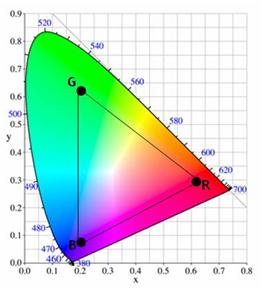
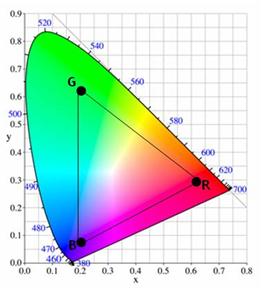 The diagram on the right is a standard type of diagram used to display color spaces (the colors that can be depicted by a given device). The shaded area represents the colors in nature that the human eye can see. The triangle is a representation of the RGB color space.
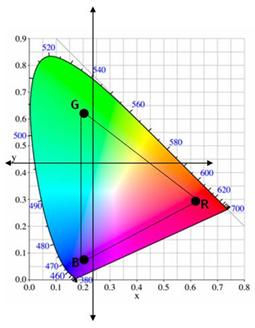 The new xvYCC color standard is a real innovation. Current color standards represent only a small portion of colors that are viewable by the human eye.
By implementing the xvYCC color space standard, HDMI 1.3 removes virtually all limits on color selection and supports 1.8 times as many colors as existing HDTV signals. This is because the xvYCC color space standard defines colors by means of an algorithm that can specify any color in nature. This lets HDTVs display colors more accurately and with more natural and vivid colors. The first TV to use this standard was the Sony Bravia, which premiered at the 2006 CES in Las Vegas.
The new xvYCC color standard is a real innovation. Current color standards represent only a small portion of colors that are viewable by the human eye.
By implementing the xvYCC color space standard, HDMI 1.3 removes virtually all limits on color selection and supports 1.8 times as many colors as existing HDTV signals. This is because the xvYCC color space standard defines colors by means of an algorithm that can specify any color in nature. This lets HDTVs display colors more accurately and with more natural and vivid colors. The first TV to use this standard was the Sony Bravia, which premiered at the 2006 CES in Las Vegas.
 Higher refresh rates (up to 120hz) for smoother motion, less blurring and better gaming (faster response time).
Double the bandwidth
HDMI 1.3 increases its single-link bandwidth from 165MHz (4.95 gigabits per second) to 340 MHz (10.2 Gbps) to support the demands of future high definition display devices, such as higher resolutions, Deep Color, and high frame rates.
The foundation has been set for even higher bandwidths over a single-link. With double-link, if implemented, the 10.2 Gbps could virtually be doubled, if ever needed. How the possibility of several 1080p/60fps running simultaneously over HDMI for future applications sounds to you?
Deep Color
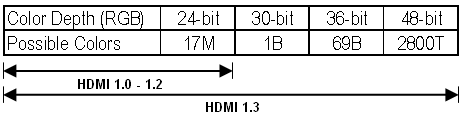
As mentioned before, HDMI 1.3 supports 30-bit, 36-bit, and 48-bit (RGB or YCbCr) color depths, up from the 24-bit depths in previous versions of the HDMI specification. With the adoption of Deep Color and the xvYCC color space HDMI 1.3 removes the previous interface-related restrictions on color selection. HDMI 1.3 enables manufacturers to build devices that can represent any color in nature, with as fine detail as can be seen by the human eye. The interface will no longer be a constraining pipe that forces all content to fit within a limited set of colors, unlike all previous video interfaces. In other words, this will let HDTVs and other displays go from millions of colors to billions of colors. Significantly, the increased color bit-depth of HDMI 1.3 eliminates on-screen color banding, for smooth tonal transitions and subtle gradations between colors. This enables manufacturers to deliver significantly increased contrast ratio.The diagram on the right is a standard type of diagram used to display color spaces (the colors that can be depicted by a given device). The shaded area represents the colors in nature that the human eye can see. The triangle is a representation of the RGB color space.
The new xvYCC color standard is a real innovation. Current color standards represent only a small portion of colors that are viewable by the human eye.
By implementing the xvYCC color space standard, HDMI 1.3 removes virtually all limits on color selection and supports 1.8 times as many colors as existing HDTV signals. This is because the xvYCC color space standard defines colors by means of an algorithm that can specify any color in nature. This lets HDTVs display colors more accurately and with more natural and vivid colors. The first TV to use this standard was the Sony Bravia, which premiered at the 2006 CES in Las Vegas.
Greater PC/CE convergence
HDMI was enhanced for easier integration into low voltage, AC-coupled PC graphics controllers, cementing HDMI's position as the de facto standard digital multimedia interface enabling true convergence cross PC and CE platforms. The HDMI Founders also support compatibility between HDMI and the Unified Display Interface (UDI), the HDMI-compatible digital video interface for PC displays announced recently by a group of leading PC technology makers.Higher resolution and Refresh Rates
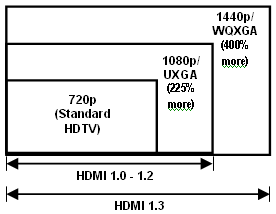
Over 400% greater resolution than 720p HDTV for greater detail and larger display sizes
Higher refresh rates (up to 120hz) for smoother motion, less blurring and better gaming (faster response time).