HDMI Part 4 - 1.3 Backward Compatible with non-1.3 Equipment? How?
Rodolfo La Maestra • August 3, 2006
HDMI Part 4 - 1.3 Backward Compatible with non-1.3 Equipment? How?
This part concentrates on the video capability of 1.3 for backward compatibility; multichannel audio capability is covered in Part 5, the next article in this series.
As mentioned before, version 1.3 adds the capability of 30-bit, 36-bit, and 48-bit pixels, which in 4:4:4 (the primarily target) means 10-bit, 12-bit, and 16-bit per component.
Video Processing the Basic 8-bits
The 10-bit and 12-bit extensions for HDMI 1.3 are useful for any source or processor that does video processing and expand the 8-bit data word.
The same applies to the internal video processing on some displays. They expand the number of bits required for the transparent support of an 8-bit/component signal, and do operations to minimize color banding. Silicon Image indicated that, and I quote, "an 8-bit signal going to an 8-bit panel without sufficient dithering could be expected to have more banding than the original 8-bit signal."
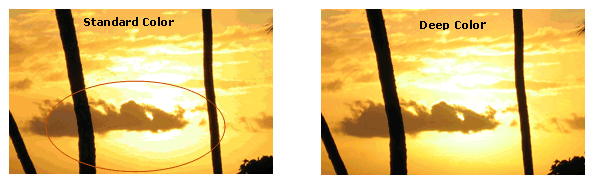
Color banding is actually more evident on a display with a greater contrast ratio. As the "distance" between black and white gets bigger, it is easier to see the jumps between each color step.
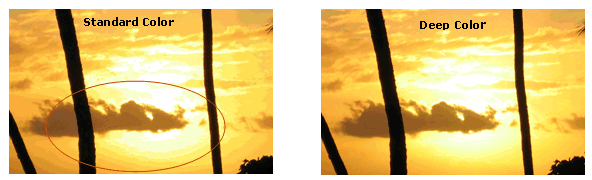
Eliminates color banding
Deep Color and Compatibility
Since the HDMI 1.3 pipe can support the deeper color, if the displays gradually increase the support of the deeper color feature, then we may begin to see some content mastered with deeper color, in addition to the PCs and game machines sources, which are generating their own content - they are not strictly playing back 8-bit content.
The sink (receiver HDMI chip) indicates which deep color modes it can support. The source (HDMI chip on the transmitting device) then acts and adapts appropriately.
When a deep color-capable source encounters a normal sink, it has to deliver normal (24-bit) pixels. How a source does that mapping is entirely up to the source. Likewise, when a deep color-capable sink receives a normal 24-bit stream from a normal source, it will adapt according to the limited signal. A variety of different techniques may be appropriate for different applications.
The Deep Color feature of HDMI 1.3 does not affect the physical or encoding layers - it is a higher-level function. The 8-to-10 bit TMDS encoding is not changed, and will never change in HDMI because "that is how the bits are able to withstand the arduous journey across the cable" in the words of Silicon Image.
The deeper color pixels are transmitted using a higher clock rate and use the additional bandwidth to pack 4 larger pixels where there were 5 pixels before, or 2 larger where there were 3 before. In this 3:2 case, the 72 bits used for those three pixels are split into 2 pixels with 36 bits each.
An HDMI "transmitter chip" typically will output whatever color depth is given from the MPEG or DVD chip that is delivering the video.
Though MPEG2 is always 8-bit, video processing on the source may expand the 8-bits to 10 or more bits, although not necessarily creating more color gradations. The processing has shifted the boundaries of the color, taking more than 8-bits to accurately represent the signal.
Therefore, even in the case of standard DVD or STBs, the use of the deep color feature could lead to a quality improvement. However, the most exciting applications are those where the content itself has more than 24-bit color depth.
HDMI suited equipment and cables would have to pass the Simplay tests to have the right to the logo representing 1.3 capabilities. More information will be included in Part 8 dedicated to Cables and Part 10 "Meeting the Standard".
Stay tuned for Part 5 "Audio in HDMI Versions".