
articles
HDMI Part 8 - Cables for 1.3
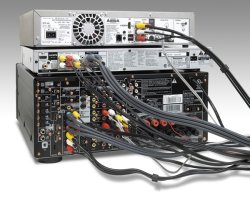
Before we get into Cables for 1.3 and 1080p let me bring up some issues about cables in general.
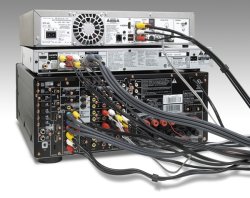 The problem is: "How could one determine the true value of the so called "better" cable?
As with many other products, there are better-constructed cables with better materials and better plugs, but this industry that offers a cable for $20 while other company sells a similar application cable for $300, has certainly created a lot of uncertainty among consumers, and when quality in a cable performance is not easy to detect those consumers become skeptical.
Consumers need to know which is a good return for their investment when buying a cable relative to their system. Paying more for claimed cable quality might become a waste of money passing certain point. How could you determine that point on your system?
Would your system have sufficient quality to easily help you determine which cable is better? Hi-end systems could show cable quality differences better. Low-end systems might never have the capability to show what a better cable can do; so why pay more for those cables if you cannot see the difference?
However, even when many systems out there are actually capable to show differences without being hi-end, most people are unable to determine audio or video differences in comparisons unless they are coached on what to look for, that makes the cable issue more difficult to understand for regular consumers.
Some people buy several cables, test, and choose one (or none). Some people rather trust their research and analysis, and hear and view how good is their cable choice mainly justified by their imagination. Some people rather trust only companies from which they have bought before, and assume they could not go wrong with those.
Many people buy the cheapest cable they could find in the Internet and their eyes glow when they saved $5 on free shipment and no tax, then they use that cable to connect their $5000 HDTV, and convince themselves that is perfect, you see?" No difference! Every one else is wrong!
Some people use the cable that came with the equipment, which generally is provided for convenience but historically could be easily improved.
So, you might say "thanks for letting me know about all the circus, but now just tell me what to buy, and I hope I would not have to pay more than the zip cord on my desk lamp; my cousin has done all his hi-end cables with Home Depot zip cord and he sees no difference, he is now thinking about doing an HDMI cable that way."
Frankly. Your call. Your pocket. Your HD system.
This is just a simple brainstorming of points of view to motivate fair thinking without taking positions and impose those positions to everyone else that did not follow that path. Regardless what your preferences are, consumers should respect each other's cable choices; that is what is missing on most exchanges dealing with cables, there is a lack of respect for each other's decisions, specially respect for those that can actually hear or see differences in quality and chose a quality cable due to that.
Now, let us see what HDMI says about cables.
The problem is: "How could one determine the true value of the so called "better" cable?
As with many other products, there are better-constructed cables with better materials and better plugs, but this industry that offers a cable for $20 while other company sells a similar application cable for $300, has certainly created a lot of uncertainty among consumers, and when quality in a cable performance is not easy to detect those consumers become skeptical.
Consumers need to know which is a good return for their investment when buying a cable relative to their system. Paying more for claimed cable quality might become a waste of money passing certain point. How could you determine that point on your system?
Would your system have sufficient quality to easily help you determine which cable is better? Hi-end systems could show cable quality differences better. Low-end systems might never have the capability to show what a better cable can do; so why pay more for those cables if you cannot see the difference?
However, even when many systems out there are actually capable to show differences without being hi-end, most people are unable to determine audio or video differences in comparisons unless they are coached on what to look for, that makes the cable issue more difficult to understand for regular consumers.
Some people buy several cables, test, and choose one (or none). Some people rather trust their research and analysis, and hear and view how good is their cable choice mainly justified by their imagination. Some people rather trust only companies from which they have bought before, and assume they could not go wrong with those.
Many people buy the cheapest cable they could find in the Internet and their eyes glow when they saved $5 on free shipment and no tax, then they use that cable to connect their $5000 HDTV, and convince themselves that is perfect, you see?" No difference! Every one else is wrong!
Some people use the cable that came with the equipment, which generally is provided for convenience but historically could be easily improved.
So, you might say "thanks for letting me know about all the circus, but now just tell me what to buy, and I hope I would not have to pay more than the zip cord on my desk lamp; my cousin has done all his hi-end cables with Home Depot zip cord and he sees no difference, he is now thinking about doing an HDMI cable that way."
Frankly. Your call. Your pocket. Your HD system.
This is just a simple brainstorming of points of view to motivate fair thinking without taking positions and impose those positions to everyone else that did not follow that path. Regardless what your preferences are, consumers should respect each other's cable choices; that is what is missing on most exchanges dealing with cables, there is a lack of respect for each other's decisions, specially respect for those that can actually hear or see differences in quality and chose a quality cable due to that.
Now, let us see what HDMI says about cables.
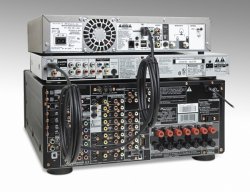 HDMI Licensing said that they do not have anything in detail written up but "the single most important factor in an HDMI cable is to have low "intra-pair skew", which is a fancy way of saying that the wires in the cable should be exactly the same length."
And they added, "Intra-pair means that what really matters is the relative length of the two wires ("D+" and "D-") in each data pair. Reliability is not impacted by one pair being substantially longer than another pair but it is severely impacted if the two wires within a pair are substantially different."
Interestingly, they have seen an almost inverse relationship between cable performance (primarily impacted by intra-pair skew) and cable thickness, which unfortunately could be very roughly generalized as "the more you pay (and I add "for thickness to impress, not necessarily for the higher cost of quality") the lower the performance". The suspicion is that it has something to do with the difference in manufacturing technique for thicker-gage wires, for which it might become harder to get consistent tensioning.
The lesson quoted from HDMI Licensing to the cable makers is: "you have always designed for analog, but HDMI uses digital, differential signals, in Gbps. Manufacturers can't keep using the same technique that they have used in the past."
Another case was from a person that had paid over $200 for a premium quality HDMI wire from a famous name of cable manufacturing (you know the name) and was having problems with the 1080p inputs of a Brillian 1080p RPTV; after much troubleshooting Brillian suggested another cable, it worked. The HDMI cable was not capable for 1080p transport, even at the high price, more on cable categories below.
HDMI Licensing said that they do not have anything in detail written up but "the single most important factor in an HDMI cable is to have low "intra-pair skew", which is a fancy way of saying that the wires in the cable should be exactly the same length."
And they added, "Intra-pair means that what really matters is the relative length of the two wires ("D+" and "D-") in each data pair. Reliability is not impacted by one pair being substantially longer than another pair but it is severely impacted if the two wires within a pair are substantially different."
Interestingly, they have seen an almost inverse relationship between cable performance (primarily impacted by intra-pair skew) and cable thickness, which unfortunately could be very roughly generalized as "the more you pay (and I add "for thickness to impress, not necessarily for the higher cost of quality") the lower the performance". The suspicion is that it has something to do with the difference in manufacturing technique for thicker-gage wires, for which it might become harder to get consistent tensioning.
The lesson quoted from HDMI Licensing to the cable makers is: "you have always designed for analog, but HDMI uses digital, differential signals, in Gbps. Manufacturers can't keep using the same technique that they have used in the past."
Another case was from a person that had paid over $200 for a premium quality HDMI wire from a famous name of cable manufacturing (you know the name) and was having problems with the 1080p inputs of a Brillian 1080p RPTV; after much troubleshooting Brillian suggested another cable, it worked. The HDMI cable was not capable for 1080p transport, even at the high price, more on cable categories below.
 There are implications in material & manufacturing methods for HDMI cables to be able to support 1080p resolutions, which is twice the data rate of 720p & 1080i. HDMI 1.3's equalizer technology provides an elegant way to allow 1080p (150MHz) compliant cables to be extended to work all the way up to 340MHz.
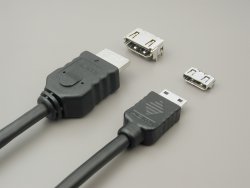
If a cable maker wants to be able to rate his cable as supporting >165MHz speeds, that cable must be re-submitted to be verified for the higher speed. However, if the cable has passed the HDMI test for 165MHz, it should pass the new HDMI 1.3 test all the way up to 340MHz. Mini-connector HDMI cable picture on the right.
There are very few HDMI cable makers shipping cables that have been tested at 1080p (and thus can not claim such support). The entire HDMI cable installed base is only tested & rated to support 75MHz or 720p/1080i resolutions, and receive a term now called "Category 1" for the cable. We should be seeing a new generation of HDMI cables that will come out and be labeled with a new category of being high speed capable.
All cables that want to claim the ability to support deep color or 1080p must be tested to pass as a "Category 2" cable. Consumers who plan to run a 1080p signal to their TVs using devices such as a PS3 or Blu-ray player should make sure they obtain a Category 2 rated HDMI cable to ensure proper compatibility. Note that all cables tested by Simplay HD are Category 2 rated, and cables which bear the Simplay HD logo are available today.
What happens with the equipment connected with those capable cables? According to HDMI Licensing, all the equipment that desire to take advantage of these latest features available in HDMI 1.3 would need to be revised with newer HDMI 1.3 electronics and then tested for compliance with the applicable HDMI Compliance Test Specification.
On one of my last conversations about the subject of cables, HDMI Licensing, responding to some of the complaints about HDMI connectors disconnecting themselves from the back panel of equipment, informally indicated that they were working in the development of a locking mechanism so the HDMI plug would stay in place, however, there was no confirmation if the effort would actually be implemented and when.
Now, I am ready, my fire retardant suit is on.
Stay tuned for Part 9 "Industry Adoption of HDMI".
There are implications in material & manufacturing methods for HDMI cables to be able to support 1080p resolutions, which is twice the data rate of 720p & 1080i. HDMI 1.3's equalizer technology provides an elegant way to allow 1080p (150MHz) compliant cables to be extended to work all the way up to 340MHz.
If a cable maker wants to be able to rate his cable as supporting >165MHz speeds, that cable must be re-submitted to be verified for the higher speed. However, if the cable has passed the HDMI test for 165MHz, it should pass the new HDMI 1.3 test all the way up to 340MHz. Mini-connector HDMI cable picture on the right.
There are very few HDMI cable makers shipping cables that have been tested at 1080p (and thus can not claim such support). The entire HDMI cable installed base is only tested & rated to support 75MHz or 720p/1080i resolutions, and receive a term now called "Category 1" for the cable. We should be seeing a new generation of HDMI cables that will come out and be labeled with a new category of being high speed capable.
All cables that want to claim the ability to support deep color or 1080p must be tested to pass as a "Category 2" cable. Consumers who plan to run a 1080p signal to their TVs using devices such as a PS3 or Blu-ray player should make sure they obtain a Category 2 rated HDMI cable to ensure proper compatibility. Note that all cables tested by Simplay HD are Category 2 rated, and cables which bear the Simplay HD logo are available today.
What happens with the equipment connected with those capable cables? According to HDMI Licensing, all the equipment that desire to take advantage of these latest features available in HDMI 1.3 would need to be revised with newer HDMI 1.3 electronics and then tested for compliance with the applicable HDMI Compliance Test Specification.
On one of my last conversations about the subject of cables, HDMI Licensing, responding to some of the complaints about HDMI connectors disconnecting themselves from the back panel of equipment, informally indicated that they were working in the development of a locking mechanism so the HDMI plug would stay in place, however, there was no confirmation if the effort would actually be implemented and when.
Now, I am ready, my fire retardant suit is on.
Stay tuned for Part 9 "Industry Adoption of HDMI".
Spend more on Cables?
Now this is a sensitive area, isn't it? The purpose of this article is NOT to justify or reject the concept of spending a dollar more for "claimed" cable quality while other people rather want to save that dollar any time the term cable is mentioned. People take all kinds of corners on this matter, and many confrontations still happen with or without blind tests, with or without factual data. Many take the matter with common-sense, and say: if I am connecting a $39 DVD player it would not be wise to spend $200 on the claimed higher quality of "that premium" HDMI cable, but would probably consider investing on a better cable if the equipment I am connecting is an HDTV system that cost thousands of hard earned dollars. Why? To avoid running the risk of compromising the overall system quality, and for many, without even "noticing" a difference. Cables are one more piece of the system, and in order to strike a balance on the overall system quality, all pieces should be carefully selected.The problem is: "How could one determine the true value of the so called "better" cable?
As with many other products, there are better-constructed cables with better materials and better plugs, but this industry that offers a cable for $20 while other company sells a similar application cable for $300, has certainly created a lot of uncertainty among consumers, and when quality in a cable performance is not easy to detect those consumers become skeptical.
Consumers need to know which is a good return for their investment when buying a cable relative to their system. Paying more for claimed cable quality might become a waste of money passing certain point. How could you determine that point on your system?
Would your system have sufficient quality to easily help you determine which cable is better? Hi-end systems could show cable quality differences better. Low-end systems might never have the capability to show what a better cable can do; so why pay more for those cables if you cannot see the difference?
However, even when many systems out there are actually capable to show differences without being hi-end, most people are unable to determine audio or video differences in comparisons unless they are coached on what to look for, that makes the cable issue more difficult to understand for regular consumers.
Some people buy several cables, test, and choose one (or none). Some people rather trust their research and analysis, and hear and view how good is their cable choice mainly justified by their imagination. Some people rather trust only companies from which they have bought before, and assume they could not go wrong with those.
Many people buy the cheapest cable they could find in the Internet and their eyes glow when they saved $5 on free shipment and no tax, then they use that cable to connect their $5000 HDTV, and convince themselves that is perfect, you see?" No difference! Every one else is wrong!
Some people use the cable that came with the equipment, which generally is provided for convenience but historically could be easily improved.
So, you might say "thanks for letting me know about all the circus, but now just tell me what to buy, and I hope I would not have to pay more than the zip cord on my desk lamp; my cousin has done all his hi-end cables with Home Depot zip cord and he sees no difference, he is now thinking about doing an HDMI cable that way."
Frankly. Your call. Your pocket. Your HD system.
This is just a simple brainstorming of points of view to motivate fair thinking without taking positions and impose those positions to everyone else that did not follow that path. Regardless what your preferences are, consumers should respect each other's cable choices; that is what is missing on most exchanges dealing with cables, there is a lack of respect for each other's decisions, specially respect for those that can actually hear or see differences in quality and chose a quality cable due to that.
Now, let us see what HDMI says about cables.
The HDMI Cable
HDMI Licensing said that they do not have anything in detail written up but "the single most important factor in an HDMI cable is to have low "intra-pair skew", which is a fancy way of saying that the wires in the cable should be exactly the same length."
And they added, "Intra-pair means that what really matters is the relative length of the two wires ("D+" and "D-") in each data pair. Reliability is not impacted by one pair being substantially longer than another pair but it is severely impacted if the two wires within a pair are substantially different."
Interestingly, they have seen an almost inverse relationship between cable performance (primarily impacted by intra-pair skew) and cable thickness, which unfortunately could be very roughly generalized as "the more you pay (and I add "for thickness to impress, not necessarily for the higher cost of quality") the lower the performance". The suspicion is that it has something to do with the difference in manufacturing technique for thicker-gage wires, for which it might become harder to get consistent tensioning.
The lesson quoted from HDMI Licensing to the cable makers is: "you have always designed for analog, but HDMI uses digital, differential signals, in Gbps. Manufacturers can't keep using the same technique that they have used in the past."
Another case was from a person that had paid over $200 for a premium quality HDMI wire from a famous name of cable manufacturing (you know the name) and was having problems with the 1080p inputs of a Brillian 1080p RPTV; after much troubleshooting Brillian suggested another cable, it worked. The HDMI cable was not capable for 1080p transport, even at the high price, more on cable categories below.
Do we really need another cable for 1.3?
The HDMI specification from its inception of revision 1.0 allows cables to be designed to support up to 165MHz speeds. With HDMI 1.3's higher speeds, cables will need to undergo new testing in order to be verified for >165MHz. However, "the expectation" (as expressed by HDMI) is that any cables that pass today's HDMI test at 165MHz will pass the new test at 340MHz. This is because HDMI sinks (such as HDTVs) are required to use an equalizer technology for signal speeds above 165MHz, and this equalizer technology compensates for the signal losses when the interface is clocked all the way up to 340MHz without any modifications.There are implications in material & manufacturing methods for HDMI cables to be able to support 1080p resolutions, which is twice the data rate of 720p & 1080i. HDMI 1.3's equalizer technology provides an elegant way to allow 1080p (150MHz) compliant cables to be extended to work all the way up to 340MHz.
If a cable maker wants to be able to rate his cable as supporting >165MHz speeds, that cable must be re-submitted to be verified for the higher speed. However, if the cable has passed the HDMI test for 165MHz, it should pass the new HDMI 1.3 test all the way up to 340MHz. Mini-connector HDMI cable picture on the right.
There are very few HDMI cable makers shipping cables that have been tested at 1080p (and thus can not claim such support). The entire HDMI cable installed base is only tested & rated to support 75MHz or 720p/1080i resolutions, and receive a term now called "Category 1" for the cable. We should be seeing a new generation of HDMI cables that will come out and be labeled with a new category of being high speed capable.
All cables that want to claim the ability to support deep color or 1080p must be tested to pass as a "Category 2" cable. Consumers who plan to run a 1080p signal to their TVs using devices such as a PS3 or Blu-ray player should make sure they obtain a Category 2 rated HDMI cable to ensure proper compatibility. Note that all cables tested by Simplay HD are Category 2 rated, and cables which bear the Simplay HD logo are available today.
What happens with the equipment connected with those capable cables? According to HDMI Licensing, all the equipment that desire to take advantage of these latest features available in HDMI 1.3 would need to be revised with newer HDMI 1.3 electronics and then tested for compliance with the applicable HDMI Compliance Test Specification.
On one of my last conversations about the subject of cables, HDMI Licensing, responding to some of the complaints about HDMI connectors disconnecting themselves from the back panel of equipment, informally indicated that they were working in the development of a locking mechanism so the HDMI plug would stay in place, however, there was no confirmation if the effort would actually be implemented and when.
Now, I am ready, my fire retardant suit is on.
Stay tuned for Part 9 "Industry Adoption of HDMI".