Ed Milbourn

Ed Milbourn

Correspondent

After graduating from Purdue University with degrees in Electrical Engineering and Industrial Education in 1961 and 1963 respectively, Ed Milbourn joined the RCA Home Entertainment Division in 1963. During his thirty-eight year career with RCA (later GE and Thomson multimedia), Mr. Milbourn held the positions of Field Service Engineer, Manager of Technical Training and Manager of Sales Training. In 1987, he joined Thomson\'s Product Management group as Manager of Advanced Television Systems Planning, with responsibilities including Digital Television and High Definition Television Product Management. Mr. Milbourn retired from Thomson multimedia in December 2001, and is now a Consumer Electronics Industry consultant.

72 articles

Ed's View - The Next "Big Thing" - 3DTV

Autostereoscopic 3DTV remains technically unrealized, but converging technologies point toward viable mass-market deployment within five years. Key enablers include the ATSC 3.0 broadcast standard with native 3D support, HEVC compression at 4:4:4 sampling and 10-bit color depth, Light-Field Camera systems capable of correcting stereo depth cues that cause eye strain, and nanolens display arrays that attach multi-element optics to individual RGB sub-pixels to create unlimited glasses-free viewing sweet spots. For consumers, this means the cumbersome glasses requirement that helped derail the first wave of 3DTV could be eliminated by the end of the decade.

Columns

Ed's View: Flashback

At CES 2013, a holographic display system transmitted live via satellite from Germany demonstrated a photorealistic 3D figure that appeared to walk through bystanders, echoing a chance encounter decades earlier with early 10:1 digital video compression shown on side-by-side 13-monitor comparisons at a 1970s CES. Both technologies initially defied belief, yet the earlier compression work proved foundational to modern broadcasting. For readers tracking display innovation, the anecdote underscores how satellite-delivered holographic imaging may follow a similar trajectory from curiosity to mainstream adoption.

Columns

Ed's View: Ultra HD - Diminishing Returns?

Ultra HD television, offering at least four times the pixel density of conventional HDTV, delivers noticeable image improvement at viewing distances up to ten times the picture height for viewers with 20/20 acuity, though returns diminish as resolution approaches the limits of human visual perception. No commercial distribution infrastructure or broadcast standards (ATSC 3.0 remains years away) currently support native Ultra HD content, making upconversion of existing HDTV signals the most practical near-term application. For large front projection systems and stadium displays, advanced upconversion technology represents a compelling reason to consider Ultra HD today, even without original 4K source material.

Columns
Ed's View: Cutting the Cord with Digital Stream's HD DVR

Ed's View: Cutting the Cord with Digital Stream's HD DVR

The Digital Stream DPH-1000R HD DVR pairs an ATSC/NTSC/QAM tuner with a 320GB HDD, offering up to 38 hours of HD or 150 hours of SD recording capacity for over-the-air content with no monthly subscription fee. The unit supports component and HDMI outputs with 5.1 audio, and successfully detected all 37 available local digital channels in a challenging reception environment 25 miles from transmitters. However, its sluggish control response, limited remote range of roughly ten feet, and a VCR-era user interface make daily operation frustrating despite solid audio and video performance.

Columns

Ed's View - What's Wrong with 3DTV

3DTV adoption has stalled due to premature commercialization, with industry bodies including CEA, SMPTE, and ATSC failing to establish standards before products reached consumers. The lack of finalized 3DTV standards means that fixes for the existing installed base cannot be delivered via firmware updates, creating potential legal and financial exposure for manufacturers. For consumers who already purchased 3DTV hardware, the absence of coordinated industry standards signals continued underperformance and limited content growth in the near term.

Columns

Ed's View - Old Movies and HDTV - The Dilemma of Sound

Restored classic film musicals from the 1950s and 1960s on Blu-ray suffer from compressed, noisy monaural optical soundtracks because magnetic multichannel formats were never widely adopted outside major theaters, and Dolby Stereo noise reduction did not arrive until the 1970s - too late for the musical era. Digital audio restoration can reconstruct badly damaged tracks but often introduces phase anomalies, sibilant artifacts, and high-frequency loss. A newer technique that digitizes the optical track pattern itself rather than the detected audio signal offers cleaner results, though the economics of re-restoration remain uncertain.

Columns

Ed's View: Higher Definition?

Bandwidth constraints, not production capability, are the primary barrier to distributing 4K/UHDTV (2160p) or SHDTV (4320p) content in real time, particularly as 4G spectrum demand crowds out available airwaves. A promising alternative approach based on image 'modeling' would transmit compact model codes rather than full resolution data, with image accuracy determined by channel bandwidth rather than intrinsic resolution. This method requires quantum memory systems estimated at roughly 1K orders of magnitude beyond current consumer storage, with commercial viability projected 10 to 15 years out.

Columns

Ed's View: TV Wins Again at CES 2012

At CES 2012, 55-inch OLED displays from LG and Samsung claimed the top 'wow factor,' with their 3D capability amplifying the effect further, while Ultra High Definition TV (UHTV) at 3840 x 2160 pixels - four times the resolution of current HDTV - ranked close behind. No exhibitor combined OLED with UHTV, a pairing the author identifies as a compelling near-future prospect. Beyond display hardware, the show underscored a broader industry shift toward software-driven service ecosystems where CE hardware margins are increasingly commoditized.

Columns

Ed's View: ATSC M/H Handheld Performance

The RCA DMT 335R handheld receiver, which tunes both ATSC and ATSC M/H using a three-chip solution powered by four 1.5V AA cells, delivered reliable M/H reception in suburban Columbus, Ohio, on channels 21, 14, and 48 - often without the monopole antenna deployed. The M/H transport stream coding and pilot robustness clearly enable viable portable DTV reception, though VHF performance remains constrained by low antenna gain in compact units. The more pressing challenge is commercial: with 4G smartphone buildout accelerating and no clear monetization model, M/H risks obsolescence unless integrated into mainstream mobile platforms.

Columns

Ed's View - M/H: Does it Work?

The Hauppauge aero-m USB stick receiver, weighing under 1.7 oz. and drawing 1 to 1.5 watts, was field-tested for ATSC Mobile/Handheld (M/H) reception in Cincinnati using WLWT on Channel 35 and WXIX on Channel 29 as the only available M/H broadcasts. The device offloads all decoding to the host netbook CPU, requiring substantial processing power, while consuming roughly 15% less power in M/H mode versus standard ATSC operation. Reception held solid through a parking garage and at 70 mph on the interstate, dropping only beyond the transmitter's Grade A coverage area, making it a practical but range-limited netbook accessory.

Columns

Ed's View - THE HARVESTER - A Miracle Power Source

A concept called power harvesting proposes capturing ambient RF radiation across a spectrum of 1 KHz to 1000 GHz using an active antenna built from carbon alloy nanotubes arranged in a fractal configuration. A sensing algorithm sweeps the antenna geometrically, rectifies the aggregate energy, and stores it in a capacitor, with claimed efficiencies exceeding 80% and a sustained output of several microamps. Published on April 1, 2011, this tongue-in-cheek column presents the idea as a near-future solution for self-powering smartphones - worth reading with a healthy dose of skepticism.

Columns

Ed's View - ALL THREE WAYS: Free, Mobile and Quality

A unified broadcast migration plan proposes consolidating free over-the-air TV onto one or two existing 6 MHz stations transmitting ATSC M/H sub-channels, each capable of carrying at least five 240x425-pixel 30fps A/V sub-channels alongside a legacy MPEG-2 channel. The scheme requires two key hardware developments: a real-time video up-converter interpolating from 100K to 1M pixels per frame, and an RF converter transcoding ATSC M/H to remodulated ATSC, NTSC, and HDMI outputs for legacy sets. If adopted alongside an MPEG-2 sunset mandate, this approach could simultaneously preserve free OTA TV, enable mobile viewing, and redirect HDTV and 3D content to cable, satellite, and IP broadband.

Columns

Ed's View - M/H: How Good Does it Have to Be?

The ATSC Mobile/Handheld (M/H) standard faces real-world performance challenges rooted in the single high-powered transmitter broadcast model, where signal strength diminishes exponentially with distance and decoding reacquisition delays compound weak-signal dropouts. Compared to 3G/4G cellular services, which benefit from overlapping high-power-density cell coverage, M/H struggles at range limits and across both UHF and VHF bands, where VHF antenna design requires external elements incompatible with portable device form factors. Future deployments combining intelligent diversity antennas and distributed transmitter networks could resolve these gaps, with a projected 50% adoption rate in U.S. smartphones and vehicles within five years of launch.

Columns

Ed's View - How Mobile Capability Could Redefine and Save Over-the-air Television

The ATSC Mobile/Handheld (M/H) standard addresses a long-standing flaw in over-the-air digital television: conventional ATSC tuners fail in mobile environments due to multipath interference and rapid signal-level changes, while M/H adds robust error correction coding and training sequences to enable reliable reception in harsh conditions. Deployment costs as low as $100K per station and the near-certain integration of M/H chipsets into smartphones, tablets, and new TV receivers could rapidly expand the potential audience. If M/H gains commercial traction, OTA HD bandwidth may be gradually ceded to other delivery platforms, reshaping the future of free broadcast television.

Columns

Ed's View - UHDTV - See It Soon?

NHK's UHDTV system delivers 7680x4320 resolution at 60Hz progressive scan, representing sixteen times the pixel count of HDTV with up to 24-channel audio, and a consortium of stakeholders is planning a New York City broadcast demonstration using four simultaneous network affiliates each carrying one-fourth of the pixel stream via existing MPEG2-encoded ATSC infrastructure. Special receivers with four independent tuners will reassemble the split streams in real time, though differential phase anomalies between transmission facilities are expected to introduce visible artifacts. The demo is technically constrained and impractical for deployment, but offers a rare public glimpse of a display format that dwarfs anything currently available to consumers.

Columns

Ed's View - CES 2010

CES 2010 marked the commercial debut of 3DTV as a dominant display technology, with content partners including DirecTV, ESPN, and Discovery committing to 3D programming schedules that signal rapid mainstream adoption. The FCC's pending National Broadband Policy, expected in March 2010, loomed as a major industry disruptor, threatening OTA broadcasters' RF spectrum while accelerating competition from ATSC M/H, Flo TV, and 3G/4G video delivery services. Consumers and industry players alike face a pivotal transition as broadband access policy and display innovation converge to reshape the CE landscape.

Columns

Ed's View - HD 3DTV: The Tasks Ahead

HD 3DTV faces three unresolved challenges before becoming a consumer reality: establishing psycho-optical parameters via SMPTE's 3D Home Master standard, developing cost-effective displays capable of 1920x1080 at 120Hz stereoscopic output with over 240Hz refresh rates, and implementing backward-compatible signal distribution within existing bandwidth constraints. The leading transmission approach multiplexes left and right images into a compressed delta stream requiring roughly 1 Mb/s overhead, preserving compatibility with legacy 2D systems. Errors in stereoscopic data directly cause viewer eye strain, making empirical validation essential before any viable standard can be finalized.

Columns

Ed's View - 3DTV: The Cart Before the Horse

The 3DTV market faces a fragmentation crisis as Sony and Panasonic push incompatible proprietary display standards while standards bodies like SMPTE, CEA, ATSC, and SCTE remain mired in preliminary discussions. Thousands of already-sold '3D ready' rear-projection units lack defined performance specifications, and no agreed-upon '3D Home Master' signal format exists to anchor content production. Consumers risk investing in hardware that may be rendered obsolete or incompatible before a workable ecosystem emerges.

Columns
Ed's View - Cognitive Radio: What it Means to HDTV

Ed's View - Cognitive Radio: What it Means to HDTV

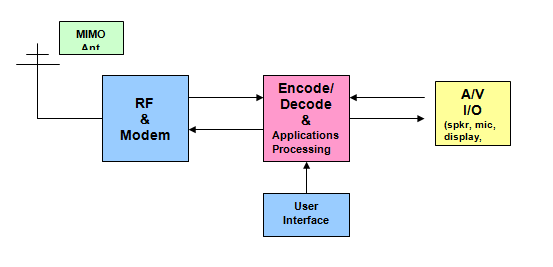
Cognitive Radio (COR) is a dynamic spectrum selection technology that continuously scans RF bands to optimize signal-to-noise ratio and quality-of-service, with current FCC-backed trials using GPS-assisted frequency lookup to exploit DTV white space for unlicensed Wi-Fi broadband. Key enabling technologies include software-defined radio architectures and MIMO antenna systems already deployed in 4G devices and DOD applications. Applied to television, COTV would allow a display to automatically select the best available signal across COFDM, VSB, QAM, and multiple network protocols including ATSC, DVB, and IP, eliminating manual source-switching for viewers.

Columns

Ed's View - HD Radio in HD

Very Low Bit-rate Television (VLBTV) is an emerging technique that leverages HD Radio's FM spectrum to transmit HDTV with six-channel audio using a psych-optical method called Image Modeling, which encodes scene data as simplified structural models paired with receiver-side look-up tables for full image rendering. The codec demands computing power and memory several orders of magnitude beyond current consumer electronics devices. If realized, VLBTV could effectively eliminate broadcast bandwidth constraints for high-definition television delivery.

Columns

Ed's View - Better Broadcast HDTV

Over-the-air HDTV is constrained by the ATSC standard's reliance on MPEG-2 compression, which reduces color component vertical resolution to 4:2:0, compared to the 4:2:2 color sampling that Blu-ray achieves using MPEG-4 encoding. The emerging ATSC Mobile/Handheld standard specifies MPEG-4 (AVC) compression and, if extended to approximately 15 Mb/s within the allocated 19 Mb/s digital channel, could support multiple full 4:2:2 HD programs alongside legacy MPEG-2 content. Whether broadcasters and standards bodies act on this opportunity will determine if OTA television can ever match Blu-ray's picture quality.

Columns

Ed's View - HDTV Broadcast Wish List

OTA television broadcasters face a critical RF performance gap, with digital tuners still struggling to handle dynamic signal reflections and bit-stream corruption across a 13:1 frequency range that strains single-band RF design limits. Emerging technologies such as ATSC Mobile/Handheld single frequency networks, circular/elliptical antenna polarization, and fractal receiving antennas could provide the roughly 2x improvement in RF parameters needed for robust service. Beyond the technical hurdles, broadcasters must also shift from a horizontal programming model toward vertical, niche-channel strategies to compete effectively against pay TV.

Columns

Ed's View - HD3D: It's Coming Fast

Consumer HD3D is gaining momentum as roughly 1000 North American screens already support 3D digital projection, and CE manufacturers are expected to sell up to two million 3D-capable HDTV monitors in a single year. Most current consumer displays are DLP-based rear-projection units using sequential 48p or 60p switched-frame stereoscopic techniques, with source material delivered via DVI/HDMI from 3D-encoded DVDs or Blu-ray. The absence of unified SMPTE and CEA standards remains the critical bottleneck, risking a format fragmentation similar to the HD DVD versus Blu-ray conflict.

Columns
Ed's View: Local HD in Indy - Lucky "13"

Ed's View: Local HD in Indy - Lucky "13"

WTHR Channel 13 in Indianapolis stands as Indiana's only local HDTV news producer, having launched its first ATSC digital signal in 1997 and achieving full local HD production in November 2006. The station's multi-year digital transformation encompassed HDTV camera acquisition, fiber-optic infrastructure, non-linear editing, and real-time HD graphics, while simultaneously maintaining its legacy NTSC analog plant. Remaining milestones include full HDTV ENG via the FCC-mandated 2 GHz BAS spectrum transition and adoption of the ATSC Mobile/Handheld standard, which could enable on-demand hyper-local news delivery.

Columns

Ed's View - Will Your Favorite TV Channel Disappear on Feb. 17th?

The U.S. digital television transition on February 17, 2009 carries a lesser-discussed technical complication: some stations in major markets will change their digital channel frequency assignments, breaking the PSIP (Program System Information Protocol) channel mapping tables stored in TV tuners. A set currently mapped to tune physical channel 25 for virtual channel 4-1 will display a blank screen if that station moves to physical channel 41. Viewers receiving off-air signals will need to manually trigger a Channel Scan from their set-up menu to rebuild the channel map, while cable and satellite subscribers should see no disruption.

Columns
Ed's View - The Atomic Power Cell (APC): Atomic Cordless Power for HDTV Monitors

Ed's View - The Atomic Power Cell (APC): Atomic Cordless Power for HDTV Monitors

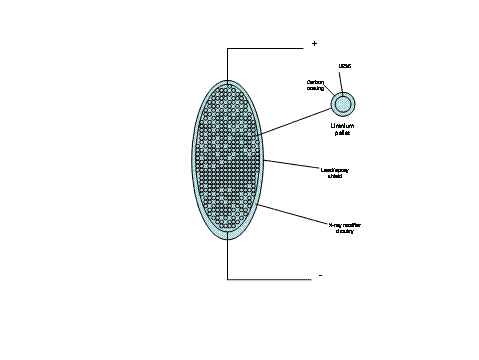
Published on April 1, 2008, this column introduces the 'Atomic Power Cell' (APC) from Atomics Unlimited, a device claimed to generate 20 volts at 60 amps of regulated DC power using compressed U-235 pellets approximately one micron in diameter housed in an eight-inch elliptical capsule. The design reportedly converts X-radiation (30 PHz to 30 FHz) via wide-band rectifiers printed on the capsule exterior, with lead epoxy carbon-fiber shielding to contain radioactive emissions. If taken at face value, such a technology would eliminate both power cords and battery recharging for HDTV displays and consumer electronics - though the publication date warrants scrutiny.

Columns

Ed's View - HDTV Quality Reduction - A Time for Action

HDTV in the US, commercialized in 1996 from NHK's 1969 research initiative, is being systematically degraded by signal compression, transcoding, and bandwidth constraints across OTA, cable, and DBS distribution pipelines. Current 1080p displays are capable of resolving far better images than the bit-starved signals they receive, leaving consumers with upscaled SD content that falls well short of true HD. Emerging solutions including Texas Instruments DaVinci single-chip processors and expanding bandwidth infrastructure offer a credible path toward delivering on HDTV's original promise.

Columns

Ed's View - Free HDTV

Over-the-air (OTA) digital broadcast delivers 25 program streams across 12 channels from a simple attic antenna at 30 miles from the transmitter, covering 90% of typical household viewing at no cost. However, local stations routinely cannibalize MPEG-2 bandwidth for low-definition sub-channels and mobile data streams, effectively reducing true HDTV throughput to roughly half its specified data rate and yielding what is closer to SDTV quality. Viewers with newer high-resolution displays will notice the difference, making high-definition disc formats currently the only reliable path to genuine HDTV.

Columns

Ed's View - Hail to the Glitches!

The US broadcast industry's transition to digital HDTV is a dual shift from analog to digital and standard definition to high definition, involving seven major technical and commercial challenges including ATSC encoder compliance failures, early DTV receiver tuner deficiencies, and costly HDTV ENG remote bandwidth constraints. With the industry estimated at only 10% along the transition curve toward consistent NTSC-equivalent quality, broadcasters are simultaneously maintaining analog SD service while rebuilding entire control room infrastructures for digital switching and HDTV origination. Understanding these compounding technical hurdles helps explain why on-air glitches persist and why the 2009 transition deadline remains a work-in-progress.

Articles

Ed's View - HDTV's 9-11

The FCC's September 11, 2007 ruling mandates that after the February 17, 2009 digital transition deadline, cable systems must carry broadcasters' HDTV digital streams while also maintaining analog carriage of main digital signals for at least three years. The ruling affects roughly 65% of US TV households that rely on cable, though it exempts all-digital cable systems from the analog requirement and does not cover secondary digital multicasts or non-cable multichannel distributors. Smaller cable operators lacking bandwidth or financial resources to support dual carriage face the greatest compliance burden and are likely to seek waivers.

Articles

Ed's View - CNBC HD + No Cigar

CNBC HD+ delivers high-quality 1080-line HD graphics occupying roughly 60% of the screen, but undermines the format by embedding a standard-definition live picture window that clashes visibly on large displays such as a 61-inch HDTV. The resolution mismatch triggers the brain's static-image processing mode, making the low-detail talking heads appear as image faults rather than intentional content. Viewers expecting a cohesive HD experience will find the hybrid SD/HD presentation a frustrating compromise that fails to justify the HD+ designation.

Articles

Ed's View - The Demise of Broadcasting

The 2009 DTV transition is forcing broadcasters to confront a fundamental spectrum dilemma: licensed digital bandwidth will be consumed by HDTV that most viewers already receive via cable, leaving OTA transmitters as an economic liability. Competing mobile/handheld (M/H) standards such as Qualcomm's MediaFLO and DVB-H are actively deploying in the auctioned 700 MHz UHF band, while the ATSC has only begun soliciting proposals for a broadcast M/H standard. For broadcasters, survival likely means abandoning OTA HDTV distribution entirely in favor of M/H multiplexing, a shift with significant regulatory and business model implications.

Articles

Ed's View - SHDTV (Part Duo)

The Digital Cinema Initiative (DCI) specification, established in 2002 by seven major studios, underpins a proposed Super High Definition Television (SHDTV) system targeting both theatrical and private home venues via satellite distribution. SHDTV operates at 4096x2160 pixels with a 250 Mbits/second compressed payload bit-rate, roughly 13 times that of standard ATSC HDTV, using lossless MJPEG 2000 compression and 48-bit per pixel color sampling. For consumers, this means a tightly controlled, non-mass-market home theater experience delivered through licensed installers under subscription or PPV models, positioned to augment rather than replace existing HDTV infrastructure.

Articles

Ed's View - SHDTV

SHDTV, a proposed super high definition television system, is positioned as a high-level supplement to the existing ATSC-based HDTV standard rather than a replacement, targeting large-screen front projection home theater installations where compression artifacts in broadcast HDTV become visually problematic. A documented technical standard for SHDTV already exists and is seeing limited commercial deployment, with 3D capability included in its specification. For consumers investing in high-end front projection systems, SHDTV represents a potential path to a true theatrical AV experience that current HDTV sources cannot fully deliver.

Articles
Ed's View - A New Light

Ed's View - A New Light

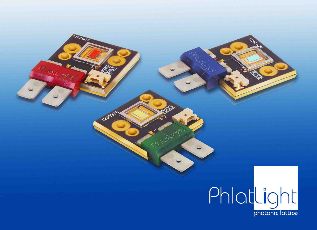
Luminus Devices' Phlatlight (Photonic Lattice Light Source) technology uses individual solid-state LED panels for each primary color, sequentially switching red, green, and blue light onto a single DLP chip to produce HDTV images free of color wheel noise and motion artifacts. The nanostructure lattice surface enables self-collimating light emission, eliminating collimating lenses and improving optical efficiency, while manufacturers such as Samsung, NuVision, and LG are already deploying the technology in rear-projection and pocket projector products. Edge-lit LCD flat panel applications using Phlatlight with light pipes are also in development, promising the same contrast and color depth gains for that display category.

Articles

Ed's View - Mobile Digital Television (MDT) This is a Winner

Sirius Satellite Radio and Chrysler partnered to deliver Mobile Digital Television (MDT) in select 2008 model year minivans and SUVs, using a proprietary overlay modulation scheme that offsets symbol angular positions within the existing 12.5MHz Sirius bandwidth to carry video without disrupting over 130 audio channels. The system employs a time and spatial dual diversity antenna to achieve a video QOS exceeding 99% in motion, with H.264/MPEG-4 encoding delivering 320x240 resolution at 15-30fps and approximately 200Kb/s per channel for animated content. Priced at $470 for hardware plus $7/month bundled service, this represents a practical in-vehicle entertainment solution targeting backseat passengers with content from Nickelodeon, Disney Channel, and Cartoon Network.

Articles

Ed's View - HDTV All the Time - The Amazing UMP

The 'Ultimate Media Player' (UMP) is a speculative concept device built around a Massive Multi-core Processor (MMP) chip containing 26 parallel processors capable of exceeding one trillion calculations per second, designed to upscale any digital video source to full 1920x1080 HDTV resolution. The system reportedly achieves 98% image accuracy from as little as 500 Kb/s of compressed video data, and delivers ten-channel audio at 95% accuracy from just 5 Kb/s. Published on April 1, 2007, this satirical piece uses technically plausible framing to explore what genuinely disruptive media processing technology might look like.

Articles

Ed's View - 3DTV - Why Not Glasses?

A fully compatible first-generation 3DTV system is technically achievable within the existing ATSC standard, requiring little modification to current 2D HDTV production and transmission infrastructure. Key enabling factors include 1080p-capable high-refresh displays for flicker-free sequential scanning, high-density pixel deposition for stereoscopic dual-image rendering, and MPEG-4 compression to multiplex 3D data within existing channel bandwidth. The primary barrier to near-term consumer deployment is not technical readiness but public acceptance of polarizing filter glasses as a viewing requirement.

Articles

Ed's View - Threats, Volume 2

A 2006 editorial identifies three additional threats to HDTV viability beyond the top tier: interconnectivity fragmentation across at least five competing standards groups, remote control and interface complexity that alienates mainstream users, and a display shortcut exploiting the human eye's roughly 80% reduced sensitivity to blue light to derive color from white pixels rather than rendering it natively. The color gamut compromise may be acceptable on small mobile screens but degrades large-screen HDTV image quality noticeably. Consumers should act as active critics, since regulators and manufacturers do respond to sustained pressure.

Articles

Ed's View - Local HDTV in Indy

WTHR (DT), Indianapolis's NBC affiliate, launched the market's first regularly scheduled live, locally produced HDTV broadcast on November 15, featuring remote HD originations from multiple locations including a regional retailer. The digital infrastructure renovation remains ongoing, with additional HDTV audio and video capability being incrementally added, and not all broadcast segments yet originating in HD. Viewers in the Indianapolis market can now access companion purchasing guidance on WTHR.com, making this a practical entry point for consumers evaluating HDTV adoption.

Articles

Ed's View - THREATS, Volume 1

HDTV faces three compounding threats that could quietly erode its technical integrity: compromised production values (lighting, camera parameters, set design), aggressive MPEG2/AVC bit-rate reductions that introduce motion artifacts and resolution loss, and Telco-driven spectrum packing of adjacent UHF channels that can push DTV reception past the desired-to-undesired signal ratio threshold, causing complete picture and audio dropout. Unlike analog OTA broadcasts, which tolerate some interference, DTV systems fail abruptly under adjacent channel energy, leaving viewers with weak signals or indoor antennas without recourse. These pressures are largely economic rather than technological, making the quality decline difficult for consumers to detect or resist.

Articles

Ed's View - The DirecTV HR20 - DirecTV Local Channel HDTV DVR, Part 2

The DirecTV HR20 DVR requires a Ka/Ku band AT9 dish with five LNBs receiving signals from satellites at five orbital positions, plus external B Band converter modules that up-convert IF frequencies from 250-750MHz into the HR20's 950-2150MHz band-pass range. Local HDTV channels are transcoded to MPEG4 and delivered via DirecTV's private fiber network before satellite uplink, with picture quality matching direct off-air reception at 3x viewing distance. Despite strong HDTV performance, persistent software bugs affecting lip-sync, PCM-to-Dolby 5.1 switching, and system stability make the HR20 a product better suited to early adopters than general consumers.

Articles

Ed's View - The DirecTV HR 20- DirecTV Local Channel HDTV DVR, Part 1

The DirecTV HR 20 HD DVR promises local HDTV channel reception via an integrated ATSC tuner, but a small sticker on the carton quietly defers that off-air antenna capability to 'late 2006.' In practice, the unit receives only two of the advertised five local HDTV feeds, with no DTV multiplex support and no firm timeline for expanded channel availability. For early adopters weighing this leased hardware, the gap between marketing claims and actual functionality makes the HR 20 a premature purchase at best.

Articles

Ed's View - HDTV But No HDTV - An Indoor Antenna Will Solve The Problem

Receiving free over-the-air DTV and HDTV via a simple indoor UHF antenna costing $20 or less is a practical solution for viewers whose cable or satellite provider lacks local HDTV coverage. Testing conducted from 20+ statute miles away using a first-generation RCA DTC100 tuner confirms that even snowy analog UHF reception typically predicts successful DTV decode, though moving reflections from leaf flutter or in-room activity can cause picture freezing and blocking. Antenna reorientation or elevation to reduce multipath interference is often all that is needed to achieve reliable reception.

Articles

Ed's View - IPTV

IPTV adapts TCP/IP networking for streaming video by replacing TCP's guaranteed-accuracy retransmission logic with UDP's guaranteed-time delivery model, enabling broadcast-quality television including HDTV over existing infrastructure. DSL connections over standard POTS twisted-pair lines can typically support at least three MPEG 2 SDTV channels simultaneously with broadband Internet and VoIP, while providers are upgrading to MPEG 4 AVC codecs to meet HDTV demands. For consumers, this means a single telephone line could eventually deliver TV, Internet, and voice services together, though compatibility across IPTV systems is not guaranteed due to fragmented protocol and codec standards.

Articles

Ed's view - The Interactive "Cable Ready" Standard

Negotiations between the Consumer Electronics Association and the cable industry to establish a bidirectional Interactive Cable Ready standard based on OCAP (OpenCable Application Platform) have stalled after nearly 2.5 years, with over 2 million unidirectional CableCARD devices already deployed since 2004. Core disputes center on OCAP's resource management architecture, which was designed for dedicated set-top boxes and conflicts with multifunction CE devices, as well as content protection controls, CableLabs licensing overreach, and the near-impossible testing matrix created by multiple OCAP implementations across varied cable headends. Consumers seeking integrated cable-ready TVs without separate set-top boxes remain caught in the middle while IP-based interoperability standards from telecom competitors may ultimately reshape the landscape.

Articles

Ed's View - A Parallel World

A proposed parallel-pixel HDTV transmission system from researchers at the University of Uzbekistan assigns each RGB sensor cell its own nano-computer that digitizes, encodes, and compresses data using lossless Motion JPEG-like compression with statistical multiplexed TDMA and QAM-derived modulation, requiring over 90 THz of bandwidth delivered via UV laser over fiber optic. The scheme revives the earliest parallel-wire television concept, scaled to over six million individual cell processors in a modern sensor array. If realized within the predicted 15-20 year timeframe, the system promises artifact-free images free of scanning or compression distortion.

Articles

Ed's View - Connections

HDTV sets in the mid-2000s featured a rapidly expanding array of digital interfaces, from HDMI's 5Gbps uncompressed A/V capability supporting all 18 DTV formats and eight audio channels, to IEEE 1394 FireWire supporting up to 800Mbps for real-time compressed HDTV streams. Emerging wireless standards such as Wi-Fi (IEEE 802.11) with multimedia data rates up to 1.6Gbps and WiMax covering 30-mile ranges at 70Mbps further complicated the landscape. For consumers, HDMI represents the most future-proof investment, while keeping the display long-term and treating source boxes as replaceable components is the most practical approach.

Articles

Ed's View - MPEG-4 AVC

MPEG-4 AVC (H.264) delivers 50% to 60% greater coding efficiency over MPEG-2, enabling quality video at bit rates as low as 50 Kbps for low-resolution output and up to 7 Mbps for full 1920x1080/24p HDTV. Early adopters include Apple's QuickTime 7 codec, Sony's PSP and PS3, and emerging multi-channel HDTV services via DBS, cable, and DSL platforms. For viewers, this translates directly into more HDTV channels from existing bandwidth, with future MPEG-21 integration expected to add DRM capabilities to the compressed digital stream.

Articles
Ed's View - DLP

Ed's View - DLP

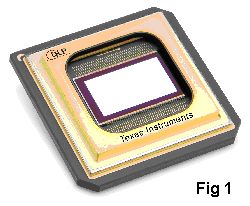
DLP (Digital Light Processing) technology, developed by Texas Instruments, uses an array of over two million individually addressable micromirrors that pivot approximately +/-10 degrees to modulate light digitally, enabling high-quality HDTV projection. Three color generation methods exist: a three-chip system splitting RGB light for maximum brightness, a single-chip rotating color wheel for cost-effective consumer use, and a newly demonstrated all-electronic switched RGB LED approach first shown at CES 2006. For consumers, the LED-based single-chip solution promises lower cost and mechanical simplicity compared to rival LCD and LCoS projection technologies.

Articles

Ed's View - Plasma

Plasma display technology operates by applying 100 to 200 volts across xenon-filled glass cells, ionizing the gas to produce ultraviolet light that excites phosphor coatings to emit visible color. A 1920x1080 HDTV plasma panel contains over six million individual cells, each driven digitally through subfield modulation across 10 to 20 subfields per frame to achieve fine brightness gradients. For consumers, this means plasma delivers a 180-degree viewing angle, no backlight requirement, and sharp resolution without optical components, making it the most economical choice for flat panel displays above 40 inches.

Articles

Ed's View - CES 2006 Trends

CES 2006 highlighted three emerging technologies poised to reshape HDTV: LED light sources offering expanded color gamut and wide dynamic range to replace conventional lamps, Field Emission Displays (FED/SED) demonstrated by Toshiba as pixel-sized vacuum cells delivering CRT-quality self-illumination in a flat form factor, and in-home HDTV digital networks still hampered by competing proprietary standards. A nascent glasses-free 3D-TV demonstration hinted at longer-term possibilities, while the near-universal adoption of HD across display systems signaled a clear industry inflection point.

Articles
LCoS

LCoS

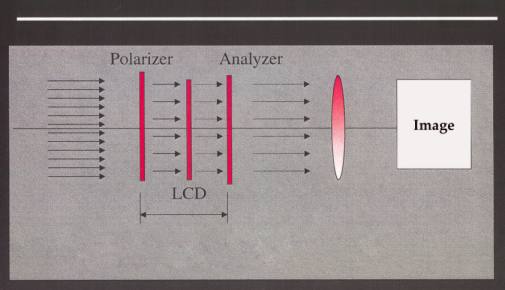
LCoS (Liquid Crystal on Silicon) is a reflective microdisplay technology that achieves fill factors of 90% or greater by relocating pixel-driving circuitry to the chip edge, compared to LCD's transmissive design where drivers consume up to 50% of each pixel's surface area. Sony's SXRD and JVC's D-ILA are both LCoS derivatives that leverage standard IC fabrication processes on a silicon backplane, reducing manufacturing costs while enabling smaller chip sizes or higher brightness for larger screens. After years of yield and reliability challenges, LCoS production appears to have reached commercial maturity, making it a practical option for high-performance home theater projection.

Articles

Ed's View - Chicken Little Was Right

The Digital Cinema Systems Initiative (DCI), adopted by a consortium including Disney, Fox, and Warner Bros., enables electronic digital distribution and projection at 2048x1080 resolution, with Real D's 3D system pushing frame rates to 144 fps to deliver alternating 72 fps left/right images through a polarizing filter system. Disney's Chicken Little served as the commercial debut of this technology across 88 subsidized screens at $135,000 per installation, with Technicolor Digital Cinema planning to equip up to 15,000 North American theaters within a decade. For moviegoers, this signals a genuine shift in the theatrical experience, with 3D projection that avoids the eye strain of 1950s-era gimmicks and multiple 3D titles already slated for 2006.

Articles

Ed's View - DirecTV HD DVR

The DIRECTV HD DVR HR 10-250 pairs dual DBS and ATSC tuners with a hard drive capable of storing up to 200 hours of SDTV or 30 hours of HDTV, outputting via HDMI and optical SPDIF with Dolby Digital support. Its server-style recording preserves the original ATSC/DBS bit stream without transcoding, delivering faithful playback quality. However, chronic software instability requiring cold resets of roughly ten minutes, a deeply nested non-intuitive menu system, and a poorly designed remote control make this a product best suited to technically experienced users willing to tolerate its shortcomings.

Articles

Ed's View - HD3D

A patented HDTV 3D system claims full ATSC compatibility without requiring glasses, using a dual-imager camera that subtracts binocular signals to produce a low-data-rate difference stream inserted into the ATSC digital transport as a separate PID. The display, built around a roughly four-million-pixel plasma or LCD panel, uses micro-lens arrays and prisms mounted per pixel pair to optically separate left and right sub-frames, delivering a wide-angle 3D image with no viewing sweet spot and no reported eyestrain. The primary barrier to adoption is manufacturing cost, as each display currently requires hand assembly over several hours.

Articles

Ed's View - KISS

Consumer confusion during the DTV transition stems partly from HDTV-labeled sets displaying upscaled content, leading many cable and DBS subscribers to believe they already receive true high-definition programming. The author outlines a practical communication framework built around three core buyer motivators - styling, capability, and performance - and highlights concrete HDTV benefits including four times the picture detail of standard TV and Dolby Digital surround sound. For early adopters advising friends and family, keeping explanations brief and benefit-focused is more effective than detailing technical specifications.

Articles

HDTV and the Brain and Why HDTV always Looks Good

Human visual acuity peaks at roughly one arc-minute (1/60 of a degree), equivalent to resolving one pixel of a one-million-pixel HDTV image at approximately three times the picture height, yet HDTV appears sharper than SDTV at far greater distances. The brain operates as a hybrid analog-digital system, using stored image references to interpolate incoming visual data, meaning higher-quality input reduces the computational load required for accurate image reconstruction. For viewers, this explains why HDTV's increased pixel density and reduced noise artifacts translate directly into a more effortless and perceptually satisfying viewing experience compared to SDTV.

Articles

HDTV and MTF - Why Projection HDTV Displays Can Never Be As Good

Modulation Transfer Function (MTF) measures how well optical components transfer contrast across spatial frequencies, and projection HDTV systems can suffer MTF values as low as 45% due to their lenses, Fresnel screens, and lenticular layers. By comparison, direct-view displays such as plasma, LCD, and CRT operate closer to 100% MTF, preserving the high-frequency detail that defines edge sharpness down to the pixel level. For consumers choosing between display types at equivalent screen sizes, this optical physics gap means a direct-view HDTV will consistently resolve finer detail than any projection-based alternative.

Articles

Ed's View - LDTV

LDTV (Low Definition Television, defined as 240 lines of resolution or less) is proposed as a broadcast service delivered over existing licensed TV spectrum using modern compression standards such as MPEG4 or Windows Media, with each station potentially carrying up to 25 channels. The 8VSB modulation standard would remain unchanged, while fourth-generation VSB tuners already provide reliable reception across grade A and B coverage areas. For viewers, this model could deliver subscription-based mobile TV through cell phone providers while preserving a free emergency broadcast tier, effectively repositioning local broadcasters as dual content suppliers to both LDTV and Cable/DBS platforms.

Articles

Ed's View - HDTV at CEDIA 2005

At CEDIA 2005, 1080p displays dominated the show floor, with consumer DLP 1080p technology using an electro-mechanical toggling mirror system that splits each frame into two sub-frames to build a full 1920x1080 image at a 20-25% retail premium over 720p models. Sony's SXRD technology, a refined LCoS implementation using polarized light reflected from an aluminum mirror, delivered the highest contrast and artifact-free performance of any display shown. Buyers evaluating high-end home theater installations will find meaningful differences in picture noise and resolution between these competing 1080p approaches.

Articles

Ed's View - Three Books

Ed Milbourn, a 38-year RCA and Thomson multimedia veteran who managed Advanced Television Systems Planning from 1987, recommends three books covering the history and business of television and HDTV development. Two titles trace the evolution of TV from mechanical systems through the inception of HDTV, while Clayton Christensen's 'The Innovator's Dilemma' examines how disruptive technologies cause established firms to fail. None require technical background, making them accessible to anyone interested in consumer electronics history or product strategy.

Articles

Ed's View - The "Film Look"

HDTV's increased image transparency compared to SDTV makes the perceptual gap between film and video origination more pronounced, exposing differences in grain structure, color saturation, and depth-of-field handling. Film's dense grain structure produces slower edge brightness roll-off than HDTV's coarser pixel grid, while film's lower color temperature and narrower color gamut yield the characteristic muted palette that video's wider gamut cannot naturally replicate. Understanding these technical distinctions matters practically because cinematographers and video producers can deliberately emulate or abandon the film look through lighting, progressive scan, 3:2 pull-down, and post-production choices.

Articles

Ed's View - The New Kid On The Block

The 1080p display format offers 1080 progressively scanned lines at up to 60fps, eliminating interlace artifacts like vertical shimmer and producing a smoother, more film-like image compared to 1080i. However, ATSC broadcast bandwidth constraints prevent 1080p at 60fps transmission, requiring display systems to up-convert 30fps source material and risking motion smear artifacts from imperfect interpolation algorithms. At typical viewing distances of three times picture height or greater, human visual perception plateaus above one megapixel, meaning real-world picture quality gains from 1080p depend more on signal processing improvements than pixel count alone.

Articles

Ed's View - The (H)DTV Transition

The US DTV transition involves competing interests from broadcasters, cable operators, CE manufacturers, programmers, and the FCC, with a proposed analog cutoff around January 1, 2009 creating significant industry friction. Cable's shift to MPEG-4 codec threatens built-in MPEG-2 decoders in cable-ready sets, while the FCC mandated digital tuners in 50% of 25-36-inch sets by July 2005 and 100% by March 2006. With HDTV household penetration at roughly 13% in 2005 and the 20% threshold needed to shift from early adopters to commodity buyers, content protection gaps and competing business models remain the practical barriers consumers face.

Articles

Ed's View - Are We Being Ripped Off? Episode 2

HDTV signal quality can be degraded at multiple points in the production and distribution chain, with re-encoding at bit rates significantly below 19Mb/s being one of the most damaging compromises a local broadcaster or cable provider can introduce. Additional vulnerabilities include analog conversion by special effects equipment, inadequate tuner multi-path performance, decoder clocking errors, and improperly calibrated display parameters such as contrast, black level, and color. Consumers who suspect quality compromises in their HDTV signal chain are encouraged to contact their local provider directly.

Articles

Ed's View - Boxes

A veteran RCA/Thomson engineer examines the fundamental tension between centralized and distributed intelligence architectures in consumer electronics home networks, noting that Sony and Microsoft are each subsidizing next-generation PlayStation and Xbox hardware to capture the living room operating software standard. The distributed approach, built on IP protocol over physical layers such as Ethernet, Wi-Fi, and Bluetooth with device 'hailing' for true plug-and-play integration, is being formalized by a CEA standards working group. For consumers, the outcome of this standards battle will determine whether home A/V systems become genuinely modular and upgrade-friendly or remain locked to a single vendor's proprietary platform.

Articles

Ed's View - Keeping Honest People Honest

Content protection for HDTV relies on layered technologies including scrambling algorithms that can consume up to one-third of channel bandwidth, conditional access via Entitlement Control Messages (ECMs), and link protection protocols such as HDMI and encrypted IEEE 1394 with handshaking to block man-in-the-middle attacks. Watermarking and Encoding Rules - enabling copy permissions such as 'copy once' or 'copy never' signaled via a broadcast flag - round out the framework. For consumers, these mechanisms determine what can be recorded, how content is delivered across devices, and ultimately what high-quality HDTV programming becomes economically viable to produce and distribute.

Articles

Ed's View - Sound

The ATSC standard mandates Dolby AC-3 six-channel (5.1) audio encoding for HDTV broadcasts, with front left/right, center, left/right surround, and a subwoofer channel encoded at a reduced bit rate. Most ATSC decoders provide a digital optical or coaxial output carrying either the decoded AC-3 stream or unencoded PCM signal, enabling connection to home theater systems available for under $200. Viewers with flat panel or smaller displays can achieve full 5.1 surround sound by pairing their ATSC decoder with an affordable home theater system or at minimum a powered subwoofer.

Articles

Ed's View - The Best HDTV Display

A veteran RCA/Thomson television engineer with firsthand exposure to early HDTV development at the David Sarnoff Research Center evaluates the major display technologies of 2005, from direct-view CRT limited to a 34-inch diagonal to DLP projection with over one million micromirrors and a spinning color filter. LCD projection is identified as the top performer for large-screen use, offering superior dynamic range, black level management, and minimal artifacts, while plasma is faulted for white compression and elevated pricing relative to screen size. Emerging field emission display (SED) technology is flagged as a promising long-term alternative worth monitoring before committing to a premium purchase.

Articles

Ed's View - Are We Being Ripped Off?

HDTV broadcast quality under digital multiplexing hinges on ATSC's 20 Mbps MPEG-2 channel allocation and how broadcasters divide that bandwidth among sub-channels. When an HDTV sub-channel is starved of bits, motion artifacts such as mosquito noise, smearing, and block breakup degrade the image, though Statistical Multiplexing (statmux) dynamically redistributes bits to prevent visible quality loss. Viewers who monitor and report encoding problems play a direct role in holding broadcasters accountable and maintaining the HDTV quality standard.

Articles

Ed's View - So, What Should You Buy?

Edward Milbourn, a 38-year RCA/Thomson veteran who managed Advanced Television Systems Planning including HDTV product development, offers practical buying guidance for consumers navigating the confusing landscape of digital TV terminology and formats. He argues that HDTV display capability is roughly eight times better than average NTSC output, making the upgrade worthwhile now rather than waiting for incremental improvements. His recommendations include selecting a full HDTV receiver over a monitor or 'ready' set to ensure ATSC tuner and CableCard support, sizing the screen so picture height equals one-third the viewing distance, and adding a 5.1 channel audio system with optical digital output.

Articles