
DTV Around the World - The US DTV System, Not so Popular Around the World (Part 1)
This is a series of articles about how terrestrial broadcast digital TV is being implemented around the world.
In this first part in the series, I offer an overall view. Part 2 will cover an interview with a colleague TV engineer that is currently testing the new DTV system in Argentina (ISDB-T), with whom I collaborated over the past few years. Parts 3 and 4 will cover the technical aspects of that system, which is a better choice for Argentina and several other countries than the US system, although the selection was not technically guided.
No to ATSC
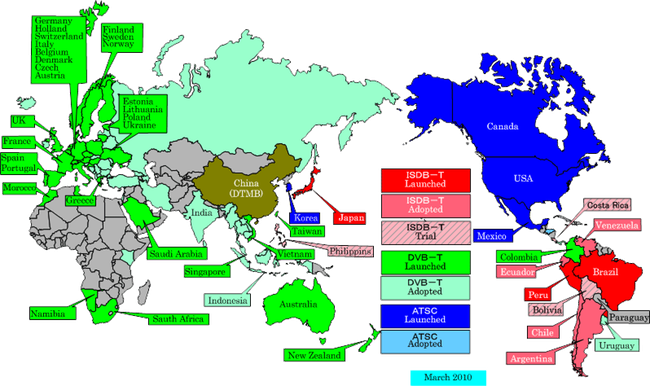
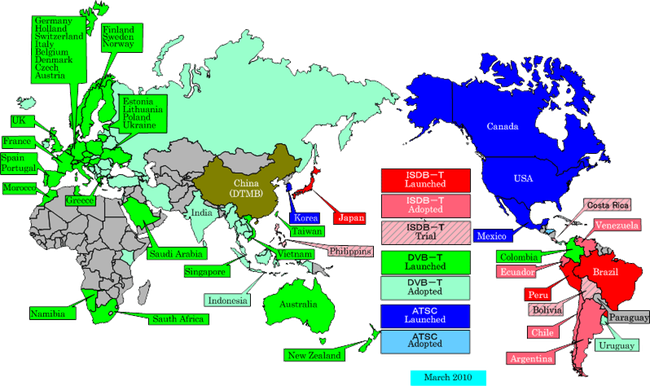
Most of the rest of the world is not adopting DTV's ATSC standard implemented in the US in 1998, except for Canada, Mexico and Korea, which already launched it (El Salvador and Honduras are said to have adopted it as well).
China is implementing their DMB-T/H terrestrial broadcasting digital TV standard and deploying it in the PRC and Hong Kong.
Dozens of countries in Europe, Asia, and Central and South America have launched or adopted the European (DVB-T) or the Japanese (ISDB-T) DTV standard, some introduced their own modifications (such as using MPEG-4 instead of MPEG-2), some adopted for political and trade reasons, and some for technical reasons, such as the ability of mobile/portable broadcasting within the same standard, not like the US did in 2009 after a decade of ATSC.
After following our considerable effort since the 1980s for developing and implementing ATSC, witnessing other countries not selecting it for political reasons is one thing but not doing it for technical reasons is disappointing, however, that partly relates to newer technology developments, such as the introduction of a more efficient compression method (MPEG-4 AVC) over our choice of MPEG-2 in the nineties.
In the US a decade of ATSC sold almost 150 million HDTVs integrated with MPEG-2 tuners for terrestrial broadcast, changing the compression standard to MPEG-4 now would make all those HDTVs incompatible and force TV owners to obtain external MPEG-4 set-top-box tuners, certainly an unpopular decision. However, if a country is just in the process of selecting a standard and the inventory of HDTVs in the public is minimal the choice is easier to make.
This standard mix reminds me of the history of the various analog TV systems implemented in the world in the last decades of the 1900s, with NTSC, SECAM, PAL-N, PAL-M, etc.
DiBEG (Digital Broadcasting Experts Group)
This organization was founded on September 1997 to promote all over the world the ISDB-T standard (Digital Terrestrial Television Broadcasting System) launched in Japan and other countries.
To achieve its main task, DiBEG promotes the exchange of technical information and the international cooperation to facilitate the common understanding of the standard in the world and the smooth exchange of programs in the digital era.
DiBEG members are basically the main broadcasters and the manufacturers working on the broadcasting business, besides associations related to the broadcasting industry in Japan.
Below is a chart that highlights what the world is doing regarding digital TV (source DiBEG):
Below is a brief comparison of the service aspects of the 3 broadcasting systems mentioned in the chart above (source DiBEG):
| Item | ATSC | DVB-T | ISDB-T |
| HDTV / SDTV fixed reception | Yes | Yes | Yes |
| Data Broadcasting | Possible (note 1) | Possible (note 1) | In service |
| SFN (Single Frequency Network) | No | Yes | Yes |
| HDTV mobile reception | Impossible | Impossible (note 2) | Good |
| Portable reception by Cellular phone | Impossible | Possible (note 3) | Good |
| Internet access | No good | Possible | Good |
(Note 1) For ATSC and DVB-T, actual commercial service is not popular.
(Note 2) For DVB-T, SDTV mobile reception is possible.
(Note 3) In case of DVB-T, another frequency should be required for portable reception service.
This ISDB-T report describes some of the advantages ISDB-T has over other systems, such as, "segmented OFDM Transmission" and "Time interleave".
Standard Selection - What Some of the World Experts Say?
(Quotes sourced from “TV Technology magazine last year):
According to Robert Graves, Chairman of the ATSC: “Fourteen years ago, the ATSC set the goal of seeing a common standard being accepted across the Americas. It hasn't worked out that way, we now have three standards in the region; four, if the Chinese succeed in getting into the market as well.
And he added "Back in 2006, Japan promised to build an IC plant in Brazil if they chose the ISDB-T standard. Three years later, there is no Japanese IC factory in Brazil and no plans to build one. But the country is now committed to its own version of ISDB-T-namely SBTDV-T-and is trying to sell it internationally".
According to Guillermo Wichmann, speaker of Argentina's DVB Coalition: "Each country is selecting what better suits their objectives, investment, employment, financing and cooperation commitment of the industries supporting each standard, as well as the payment of intellectual property rights royalties to the owners of each HDTV standard".
And he added “DVB in Colombia is going faster than ISDB-T in Brazil or ATSC in Mexico, transmission and set-top box costs are other major factors affecting the DTV roll-out. Other countries still have to make their standard decisions, assign new digital frequencies and plan their analog switchovers".
Argentina finally selected ISDB-T, is doing testing in 2010, and expects to launch the system shortly this year; more on this in part-2 of this series.
Peter Siebert, executive director of the DVB Project, agreed with ATSC's Graves: "Political cosiderations often play a strong role in the decision process and sometimes outweigh the technical and commercial advantages of a particular standard".
Regarding how political is the ISDB-T standard choice made by Brazil, Alvaro Gutierrez, an executive with the DTV equipment manufacturer SIDSA, a Madrid, Spain-based developer of DVB-based technology, said "Brazil has a new standard and it is working pretty bad, but Lula Da Silva is pushing very hard politically to its neighbor countries to choose ISDB-T. So Brazil could export the technology in the region. But it's clearly a bad standard for the region; very expensive."
Regarding the importance of low cost of receivers for selecting a standard, Raj Karamchedu, director of product marketing of Legend Silicon Corporation in California, who helped develop China's DMB-T/H standard, commented:
"There are 380 million television households in China alone, and the government there has set 2015 as the analog cutoff. Add [to that] the ability of this standard to support mobile DTV reception in moving buses-which is very big in China- [and] the potential for mass producing this technology in cost-saving volumes is very high."
Stay tuned for part 2, the implementation of ISDB-T in Argentina.