HDTV Magazine
Welcome, Anonymous  •  Sign In  •  Register  •  Help
Receive instant notification of new articles: Register Now to receive notification of new HDTV Magazine Articles via email as soon as they are published.
Rodolfo La Maestra
Passive 3DTV Brain Perception - An Excuse for Technical Limitations?
by Rodolfo La Maestra on October 26, 2011 Categories: 3D HDTV

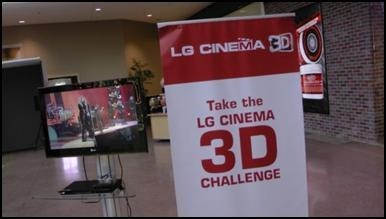
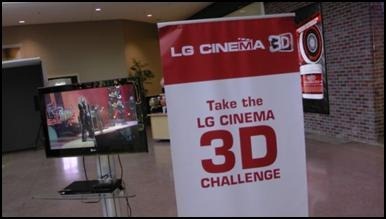
LG's Consumer Tests in Retail Centers
As you may know, LG continues their offense against active-shutter 3DTVs and claims that their passive-LCD-3DTVs are better because most people that viewed their sets during (their arranged) consumer tests in retail centers in New York, Chicago, Los Angeles, etc. preferred them over active-shutter 3DTVs.

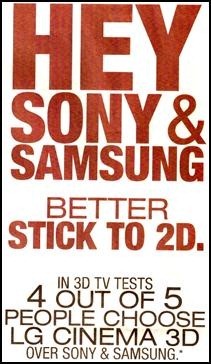
USA Today - June 30, 2011
Although the challenge seemed primarily targeted to the active-shutter technology itself, LG also launched aggressive advertising directed to the manufacturers of that technology as well, such as Samsung and Sony.

The battle of words, ads, and press releases has become rather ridiculous, and consumers and retailers are at a loss when things like this happen. Buying a 3DTV should be a joyful and rewarding experience, but is rather turning into a take-a-side undertaking, throwing bananas in the zoo’s monkey house.

LG may have limited itself to offer an alternate technology to those that may have issues with the active-shutter technology such as flicker and nausea (although that minority could also have issues accepting 3D in theaters as well), or to offer a low cost 3D glasses alternative to the relatively higher cost of the 3D active-shutter glasses, but the company appears to believe they can take over the whole 3DTV market (with their mediocre 3DTV, yes, I said that).

I cannot imagine Porsche attacking Ferrari in USA Today’s ads and tell the company to better stick to economy commuter cars or Dolby attacking DTS and tell the company to better stick with stereo. I frankly do not remember anything like this even in the Beta vs. VHS or the HD DVD vs. Blu-ray competitions, and those were actual battles for format survival not just a display device in a jungle of TVs, but even then the exchanges were handled professionally and with respect.

Ironically in this 3DTV case, the one with the lower image quality 3DTV, the one with 540 black-lines across an image that is half the resolution of 3D Blu-ray (or quarter the resolution if displaying cable/satellite side-by-side 3DTV content), has the guts to denigrate manufacturers implementing a higher quality 3DTV technology.

T2’s brain processing power is 3D8K per eye, but he 'perceived' it as just 480i with 3D-passive-glasses, I am lucky he spared my life after the test
On previous articles I covered the imaging subject of both technologies and how their images are actually displayed, but it seems passive-3DTV preachers prefer to disregard standards of TV Imaging Science traditionally used to evaluate HDTV image quality, to rather give importance only to the visual perception by the viewer’s brain on demos that can be easily manipulated with untrained viewers.

In other words, LG put emphasis on how a viewer “perceives” a 3DTV passive image rather than the quality of the actual 3D image as displayed by the TV, emphasizing that perception should be what it counts, even if the images are just at half-resolution per eye, as the passive 3D method is.

If a TV produces a good quality image it is expected for a viewer to perceive it as such, whereas a low quality TV image would inevitably be perceived as a degraded image by the viewer.

For years the Imaging Science has pursued the effort of educating the public about the importance of calibrating a TV to produce the best image it can display, following strict parameters of imaging standards, so a viewer may perceive a natural image that resembles as much as possible the original source.

If 3D can be displayed and viewed as a pair of two well calibrated good quality fully resolved HDTV images, why denigrate its quality when introducing an alternative product that may fit better a relatively small audience that may have viewing issues even in the local 3D theater.

The approach LG takes in concentrating only in how 3DTV images are perceived was supported by one recent report that “coincidentally and timely” defended the “perception” factor regardless of the quality of the displayed image, openly contradicting what most experts indicated over the past years, including myself, which is that passive 3DTV technology offers only half-resolution imaging per eye and each eye receives considerably less information than with active-shutter technology, regardless of how capable the brain may be to compensate, half of the original image has been lost. Should that technology exist? Yes, for those needing it to enjoy 3D. In other words: parallel technologies.

Cut, cut, cut. I thought they would stop when people start “noticing”

For decades, the audio and video industry has been introducing standards and codecs that in one way or another compressed signals humans hear or view, to fit restrictions of transmission, recording space, or equipment limitations.

To 'cut' corners T2 removes the 3D glasses
To “cut” corners T2 removes the 3D glasses
From analog interlaced 480i NTSC TV to fit in 6 MHz channel space, to the 16-bit 44 kHz CD sampling of a continuous analog wave of real sounds, to DTS and Dolby multi-channel audio formats with perceptual encoding and masking, to H/DTV MPEG-2 with 50-100 to 1 compression, to DVD and Blu-ray MPEG-2/MPEG-4/VC1 compression, to luminance and color sampling/compression on component analog signals, the list goes on and on, humans have been forced to accept curtailed signals that were “carefully studied” so sounds or video information that arguably may not be heard or viewed when (dis)played simultaneously with other sounds/pixels/colors can be identified and removed from the content.

Like masking very soft passages of music played with very loud ones, or filtering out sounds believed to be beyond human’s hearing threshold, although some studies determined that humans can still perceive many very high frequency sounds at various harmonic levels thru bone structure rather than timpani sensation and therefore be able to differentiate the particular timbre of instruments playing the same base note. Likewise, information can be reduced about some RGB colors the eye is more sensitive to, so they are not encoded at full bit resolution as others do.

Cutting corners in audio and video is not a new concept, one common denominator (or should I say “the typical excuse”) is: “human perception may not notice”. In other words, why bother encoding, displaying, transferring, etc. signals that humans may not notice and may not even be aware those signals existed within the original content?

Although the readers of this publication, like me, may want to defend quality eternally I honestly believe it may be a bit too late to fight a battle of quality when all the odds are against it, starting by the sad reality that a majority of people is not even educated or trained to appreciate differences in audio/video quality, and even if they do, most would only pay for the “good enough” choices.

Knowing that an original 3D image-pair was created and recorded at the source as two 1080p full resolution images, but is displayed by a passive 3DTV at half-resolution per eye using the same “good enough perception” excuse, goes against the idea of pursuing for image quality at the source to begin with, so why bother Mr. James Cameron and the others?

The passive 3D display industry seems not minded about going backwards in quality under the excuse that our brains will compensate, so a “good-enough half-resolution” Avatar version should be OK next time Mr. Cameron. However, Cameron is actually thinking in the other direction, he is entertaining the idea of increasing the 24 fps frame rate to 48 or even 60 fps to smooth out the 3D presentation, and also increasing the 3D depth of future content compared to his conservative Avatar 3D depth.

Traditionally, the subject of audio/video quality has been very abstract for most people. For many it is hard to think beyond the simple face value of the content they see and hear so they can analyze what they have “lost in the transmission” and understand what they could have seen or heard otherwise, unless actual side-by-side comparisons can be made, not by casual 3DTV images on a shopping center or central station, but with specific 3DTV patterns designed to isolate and clearly show the bad from the good, and then demonstrate how that affects real images. When that is done people would notice, then tell me what they prefer.

That type of testing is missing at most 3DTV magazine reviews perhaps because many reviewers are still waiting for 3D tools and patterns to help evaluate 3DTVs properly, as a good quality dual 2D image pair. Due to the lack of 3D tools and patterns to perform solid comparisons among 3DTVs subjective evaluations could range from “that is a nice looking image” to “I was able to view it for 3 hours with no headaches” to “my 3-year-old daughter just came into the room and said she liked this 3DTV better, besides, the frame of the 3D glasses was pink, her favorite color”.

An interesting column (“3D-What should consumers know?”) was written by industry’s renowned Imaging Science Joe Kane in a recent issue of the Wide-Screen Review Magazine, in my opinion one of the most prestigious publications regarding quality of video and audio. The column addresses exactly the same 3DTV issues I have been writing for the past 3 years. Professionally we both recommend active-shutter glasses for quality reasons, and both share the same concerns with passive 3DTV, especially how is being introduced to viewers.

On another front, brick and mortar specialized audio/video stores are disappearing rapidly, they were unique in that they took the time to teach and demonstrate what quality is about. Unfortunately, consumers would not have that opportunity anymore.

Now many consumers become DIY 3DTV experts under the umbrella of the Internet and Wikipedia, buying 3DTVs in the Web without even seeing the image, but happy about an unbeatable price. Good price deals always give purchasers the power of finding appreciation for even the worst images and most probably never admit they made a bad choice (don’t you dare saying their baby is ugly).

MP3 found a way to please a lot of people. Would you think those would be as pleased if they could have experienced a good demo of hi-end audio? 480i NTSC TV pleased many people for over half century, until 480p DVD and 720p/1080i HDTV produced the no turning back WOWs!!

Monaural pleased many people until stereo and multi-channel audio immersed them into the music and soundtracks of concerts and movies. 4:3 B&W aspect ratio movies pleased many people until color CinemaScope came to stimulate their peripheral vision and brought viewers into a movie.

A common denominator on all those is that, if economically possible, most would find difficult to go back to lower quality once the better quality is experienced.

But what happens when quality gives up in front of you before you even tasted it? What happens when the 3DTV you just purchased cannot be upgraded to ever show the original 3D quality of the source?

Next article: “The Perception of Passive 3DTV – a No-brainer Analogy”. Stay tuned

Posted by Rodolfo La Maestra, October 26, 2011 8:06 AM

Reader Commentary

Reply
memofo • Oct 27, 1:00am
I see your point, it has gotten ugly with the mud slinging between LG and Samsung. However, the public seems to not really care about 3D either way. I love 3D, though I'm on the passive bandwagon, I see it's potential. I don't see it going anywhere with cable or satellite providers offering regular shows and sports in 3D. Though blu-ray movies are better, the real aim should be focused more on video games. Passive does give you half the resolution but like you said the untrained average consumer wouldn't be able to notice. Well this is exactly why LG has a better product for consumers. It offers hassle free, comfortable, affordable 3D, that can be viewed in any light. LG's target market is the average consumers which there are a lot more of then the tech savvy consumers. Also you didn't mention LG Cinema 3D TV's ability to perform (Dual Play). This allows two people to view two separate 2D full screen images while playing video games. All passive 3D TVs can do this with a simple modif...
Reply
Rodolfo • Oct 27, 1:11pm
memofo,

As I said before, I have no objection to considering 3DTV passive technology as an alternative to other parallel technologies such as auto-stereoscopic and active-shutter glasses. I do have an objection in naming passive technology as “the best” when not all the criteria to qualify for “the best” is met, especially resolution and image quality, but also limited angle of view, which affects color, contrast and brightness depending where the viewer sits, not to mention a 540 black line FPR structure that can be easily perceived and disrupts the 3D viewing at normal distances, to mention a few.

As an alternative technology, passive 3DTV offers choice and should be welcomed as such, like any technology of any product that serves a purpose for certain needs, such as your need of dual view for video games, or flicker issues, or glasses cost (although not display device cost).

The capability of dual view has been implemented in the past by autostereoscopic in cars for driver and ...
Reply
memofo • Oct 27, 4:35pm
Thanks for the response! Your absolutely right you do get half the resolution with the passive (dual play) technology, but it's available now for all the passive 3DTVs. Yet, if you have an active shutter system you have to tinker with your expensive glasses possibly breaking them to get this to work in this way.

Sony came up with this idea for their new Play Station 24" 3DTV. But to making active (Dual Play) type glasses that sync with all of their current and previous models would be needed to compensate for what Passive TVs can already do. Yes, with the active you would see full 1080 HD, but do you think Sony will spend the money to make compatible (dual play) type active glasses for all their recent and previous 3D TV models? The most likely answer is no. That's why they came up with the new Play Station TV that offers this technology in the first place.

All 3D TVs can do this but with active it takes more effort to achieve the result because of the electronics of the glasse...
Reply
Rodolfo • Oct 27, 8:56pm
Memofo (realmente te estas mofando?),

Good points. You are forgetting that in the active-shutter technology there is also plasma, DLP and LCoS, and as a panel plasma traditionally renders a better image quality than LCD, unless you enjoy watching all content like cartoon characters in blurriness when they move. Even in 2011 models the LCD ghosting is still an issue and is not present in plasma, not to mention the poor vertical resolution of LCDs measured while the image is moving, which drops to about a half of the 1080 lines, while plasmas are still up the upper 900-1000 lines of vertical resolution according to a study performed by Pete Putman presented at a Display Search conference in California a couple of years ago.

LCD (2D or 3D) is famous for the very limited horizontal angle of view, in the range of +-10% off center that affects color, contrast and brightness, please check the research done in the subject (one in the link below). 3DTV passive adds the vertical limitatio...
Reply
memofo • Oct 28, 6:07pm
I'm not and expert but a very informative consumer who diligently researches everything I'm interested in, especially when it comes to expensive purchases. I've read the study performed in the link you provided. The problem with the study is it does not include any passive TVs. This study was performed by Dr. Raymond Soneira. This same expert did yet another recent study that I'm sure you have come across. If not I think you should read it before moving on with my comment.

http://www.displaymate.com/3D_TV_ShootOut_1.htm

I believe that active plasmas are better then active LCDs in every aspect but power consumption and heat output. Power consumption and heat output is important when it come down to pure performance. Mainly because something that may last upward of 20+ years will be taking a toll on your electric bill. I did not overlook active 3D plasma, however they again have less ben...
Reply
Rodolfo • Oct 28, 10:40pm
I agree with many of your points, reason by which I always recommend both technologies to coexist for different purposes and peoples’ needs.

The first Soneira’s report was about LCD vs. plasma, I included its link just to indicate that the weaknesses of LCD (vs. plasma) continues also in 3D passive, he did not include passive on the report because it was made before 3DTV passive was released.

On his second report I disagreed with Soneira’s conclusions on his comparison between passive and active, and I told him that, he left out of the comparison the panel with the best image quality in the market: plasma; his response was that he left plasma out to avoid more work in the comparisons. In other words, he is not comparing what passive and active technologies can do, he is comparing what LCD can do with them, and actually, what a person perceives, rather than how good is the image by imaging standards.

Also, the report says nothing about LG’ reverse pixel display on the second 120Hz...
Reply
memofo • Oct 28, 11:50pm
Rodolfo,

Thank you for your input and great responses, I do agree that Dr. Soneira did not have a complete study that showed all of what active has to offer. It turns out I have read your previous articles before without knowing you had produced them. I personally think the active vs passive feud brings competition to benefit the consumers quicker. Sony, Samsung, Panasonic and other active pushers have stepped up their game in light of LG's passive FPR tech. Allowing for universal glasses, lighter glasses and price drops. I would like to see improvements to FPR in the near future as well. I say let the TV manufactures fight, if anything just keep throwing fuel on the fire. Keep up the good work.

Best wishes,
Memofo....

More from Rodolfo La Maestra

» - Currently Reading

About Rodolfo La Maestra

Rodolfo La Maestra is the Senior Technical Director at HDTV Magazine and participated in the HDTV vision since the late 1980's. In the late 1990's, he began tracking all HDTV consumer equipment, and since 2002 he authors the annual HDTV Technology Review report covering HDTVs, Hi-def DVD, content providers, broadcast, cable, satellite, government, standards, connectivity, content protection, H/DTV tuners and DVRs, etc. In addition Rodolfo has authored a variety of tutorials, books, and educative articles for HDTV Magazine, DVDetc, and HDTVetc Magazines, Veritas et Visus Newsletter, Display Search, and served as technical consultant/editor for the "Reference Guide" and the "HDTV Glossary of Terms" for HDTVetc and HDTV Magazines. In 2004, he began recording a weekly HDTV technology program for MD Cable television, which by 2006 reached the rating of second most viewed by the public, here is the opening episode.

Rodolfo's background encompasses Electronic Engineering, Computer Science, and Audio and Video Electronics, over 4,700 hours of professional training, a BS in Computer and Information Systems, and over thirty professional and post-graduate certifications, some from American, George Washington, and MIT Universities. Rodolfo was also Computer Science professor for over 700 students in five institutions between 1966-1973 in Argentina, for IBM, Burroughs, and Honeywell mainframes. After 38 years of computer systems career, Rodolfo retired in 2003 as Chief of Systems Development from the Inter-American Development Bank where he directed 65 software-development computer professionals, supporting member countries in north/central/south America 24x7.

In parallel, from 1998 he helped the public with his other career of audio/video electronics. Rodolfo started with hi-end audio in the early 60’s and merged with Home Theater video, multichannel audio, widescreen laser disc, anamorphic DVD, 16x9 NTSC displays, HDTV, Hi-def DVD, IPTV, HDMI, and 2.35:1 Cinemascope HD Home Theater over the past 40+ years.

When HDTV started airing in November 1998, he was an early adopter of HDTV and realized that the technology as implemented would overwhelm regular consumers due to its complexity, and it certainly does even today. Rodolfo then launched his HDTV mission of educating and helping consumers understand the complexity, the challenge, and the beauty of the technology, so the public learns to appreciate HDTV not just as another television.