3DTV

Ed's View - The Next "Big Thing" - 3DTV

Autostereoscopic 3DTV remains technically unrealized, but converging technologies point toward viable mass-market deployment within five years. Key enablers include the ATSC 3.0 broadcast standard with native 3D support, HEVC compression at 4:4:4 sampling and 10-bit color depth, Light-Field Camera systems capable of correcting stereo depth cues that cause eye strain, and nanolens display arrays that attach multi-element optics to individual RGB sub-pixels to create unlimited glasses-free viewing sweet spots. For consumers, this means the cumbersome glasses requirement that helped derail the first wave of 3DTV could be eliminated by the end of the decade.

Ed Milbourn
Columns

Cox Communications brings Masters Golf Tournament to customers in 3D on ESPN 3D

Cox Communications launched ESPN 3D channel 896 for Cox Advanced TV Plus customers in Virginia, delivering stereoscopic Masters Golf Tournament coverage from April 11-14, 2013 using 6-9 dedicated cameras with 3D-specific graphics and commentary. Viewers require a 3D-compatible television manufactured March 2010 or later, Cox HD service, and an HD/DVR Trio receiver with HDMI output to access the channel. Customers without 3D hardware can still watch full Masters coverage on standard ESPN, making the 3D tier an optional upgrade rather than a replacement broadcast.

Shane Sturgeon
Bulletins

3DTV is Not Dead, It's Just Facing Reality Beyond the Hype

The ATSC A/104 Service Compatible Hybrid Coding (SCHC) standard, approved December 2012, defines a 3DTV broadcast framework using MPEG-2 for the base view and AVC/H.264 for the additional view within a single 6MHz terrestrial channel. Europe's Sisvel Technology offers a competing approach via its 3DZ Tile Format, which encodes dual 1280x720p eye images plus a depth map within a single 1920x1080 MPEG-4 frame, leaving roughly 230,400 pixels for auto-stereoscopic data. Both systems prioritize backward compatibility with legacy HDTVs, meaning viewers can receive 3D broadcasts on existing sets without a channel change, though a firmware or hardware update to MPEG-4 set-top-boxes is required for full 3D decoding.

Rodolfo La Maestra
Articles

LIONSGATE AND SAMSUNG PARTNER TO EXPAND THE AVAILABILITY OF HIGH-QUALITY 3D CONTENT IN THE HOME ENTERTAINMENT MARKETPLACE

Lionsgate and Samsung announced a partnership at CES 2013 to convert and distribute popular theatrical titles in 3D for home entertainment, using Samsung's proprietary 3D image processing technology, with GAMER, CRANK, BANGKOK DANGEROUS, and THE DESCENT as the initial releases. The initiative coincides with a tripling of 3D-enabled Blu-ray Disc releases in 2012 versus 2011, and a near-doubling of 3D television households from 3.5 million to an estimated 6.4 million. Owners of Samsung Smart TVs stand to benefit from an expanding library of premium 3D content converted from existing 2D catalog titles.

Shane Sturgeon
Bulletins

Panasonic Unveils Enhanced 2013 Smart VIERA Plasma HDTV Lineup

Panasonic's 2013 Smart VIERA Plasma HDTV lineup spans 16 models from 42-inch to 65-inch class, with flagship ZT60 and VT60 series featuring a Dual Core Hexa Processing Engine, 3000 Focused-field Drive producing 1080 lines of image resolution, and a Studio Master Panel rated for up to 100,000 hours of panel longevity. The ZT60 achieves DCI 98% Color Space via a newly developed pure red phosphor and eliminates the air gap between front glass and plasma panel to reduce crosstalk and double images. Buyers evaluating premium plasma sets will find THX-certified 2D and 3D modes, ISFccc calibration support, built-in Wireless LAN, DLNA, Bluetooth, and the new Swipe and Share 2.0 feature for seamless Android and iOS content transfer across the full ZT60, VT60, and ST60 tiers.

Shane Sturgeon
Bulletins

Epson Debuts Ultra Bright HD 2D/3D Projector Under $900

Epson's PowerLite Home Cinema 750HD is a 3LCD projector delivering 3,000 lumens of both color and white brightness at 720p resolution, with active shutter 3D support priced at $899. The projector features Bright 3D Drive Technology, RF 3D glasses with a three-minute quick charge lasting up to 40 hours, and an E-TORL lamp rated for up to 5,000 hours of life. For buyers seeking a versatile home theater solution, its broad out-of-the-box compatibility with Blu-ray players, game consoles, and cable boxes eliminates the need for a separate format converter.

Shane Sturgeon
Bulletins

Glasses-free 3D Ready For Primetime As Ultra-D Debuts 4K Displays At International Winter Consumer Electronics Show Central Hall Booth #8225

Stream TV Networks debuted its Ultra-D 2160p glasses-free 3D display technology at CES 2013, showcasing 31.5-inch and 60-inch 4K panels alongside the SeeCube real-time conversion set-top box, which converts 2D and glasses-based 3D content to glasses-free 3D at resolutions up to true 2160p. A proprietary optical system exploits inter-image disparity to produce output resolution exceeding the source material. Consumers can feed virtually any content source - including Blu-ray, cable, and streaming services - into the system without requiring dedicated 3D glasses or restricted viewing angles.

Shane Sturgeon
Bulletins

Consumers Seek, Embrace Built-In Features in HDTVs, CEA Study Finds

A CEA study on advanced HDTV features reveals that over one in five U.S. adults owns a smart app-enabled HDTV, with 90 percent actively using built-in apps and 61 percent streaming video content directly through their televisions. On the 3D front, unit sales of 3DTVs are projected to reach 5.6 million in 2012, representing 18 percent of total TV sales, and 42 percent of 3DTV owners watch five or more hours of 3D content weekly. For buyers planning a new HDTV purchase, built-in Wi-Fi and Internet browsing rank just below audio and video quality as top purchase factors.

Shane Sturgeon
Bulletins

HDTV and Home Theater Podcast - Podcast #555: Epson PowerLite Home Cinema 3010 Projector

The Epson PowerLite Home Cinema 3010, a 1080p 3LCD projector priced at $1338, delivers a measured 1424 lumens in Cinema mode, outperforming many competing projectors even in their brightest Dynamic settings. Active shutter 3D, 2200 lumens rated brightness, and a 40,000:1 contrast ratio round out a strong feature set, though black levels fall short of comparable DLP and LCOS alternatives. The critical omission of lens shift forces reliance on keystone correction, making installation impractical for ceiling-mounted home theater setups despite otherwise excellent performance for the price.

The HT Guys
Podcasts
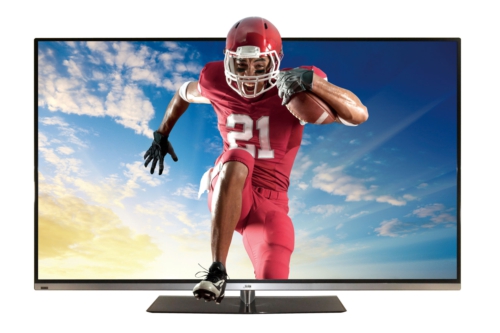
New JVC 55" XinemaView 3D HDTV Delivers Powerful Sound & Connectivity

New JVC 55" XinemaView 3D HDTV Delivers Powerful Sound & Connectivity

JVC's 55-inch JLE55SP4000 3D HDTV launches as the first model in the BlackSapphire 4000 series, featuring a 120Hz CrystalMotion panel, 1080p Full HD resolution, and a 45-watt integrated sound system with a built-in woofer and XinemaSound 3D processing. The set includes built-in 802.11n WiFi, four HDMI inputs, passive battery-free 3D glasses, and preloaded streaming apps including Netflix, Vudu, and Pandora. Priced at $1,299.99, it targets consumers who want above-average TV audio without purchasing a separate soundbar.

Shane Sturgeon
Bulletins

HDTV Expert - What If They Gave A Party, But No One Came? - Pete Putman

Despite years of heavy promotion, fewer than 115,000 American TV homes actively watch 3D content at any given time, a figure too small for Nielsen to capture meaningful viewing data, signaling a near-total consumer rejection of the format. Analyst data from HIS and NPD DisplaySearch points to 4K TV as the more viable successor, with 50-inch 4K x 2K LCD panels already priced at $800 using conventional amorphous silicon processes, and DisplaySearch forecasting 4K will represent 22% of the 50-inch-plus TV market by 2017. For consumers, 4K offers a glasses-free immersive experience compatible with all major display technologies, though content availability and delivery infrastructure remain unresolved near-term barriers.

Pete Putman
Columns

HDTV Expert - Watching the Olympics in 3D: 'DNF'

Comcast channel 981 carries the 2012 London Olympics in side-by-side frame-compatible 3D, viewable on active-shutter displays such as the Samsung UN46ES7500 46-inch LCD. Gymnastics events proved more compelling in stereoscopic 3D than diving, with close camera positioning creating genuine depth, though viewer fatigue set in after 30 to 60 minutes of continuous glasses-on viewing. Intrusive pop-up ads appearing as frequently as every 3 minutes 50 seconds and blocking 15% of the screen undermine the experience enough that switching back to standard 2D coverage becomes the practical choice.

Pete Putman
Columns

NBC Olympics & Panasonic Announce Nearly 80 Percent Of U.S. TV Households Will Receive High-Definition 3D Broadcast Feed Of The London 2012 Olympic Games

NBC Olympics and Panasonic are delivering the first-ever 3D broadcast of the Olympic Games to nearly 80 percent of U.S. TV households, with approximately 242 hours of Full HD 3D content distributed across major cable, satellite, and telco providers including Comcast, DirecTV, and Verizon. Captured using Panasonic's twin-lens Full HD 3D camera recorder systems, the next-day-delay programming covers 12 hours daily and spans events from gymnastics to track and field. Viewers with compatible 3D televisions can relive Olympic highlights in a format previously unavailable for the Games.

Shane Sturgeon
Bulletins

CEA Announces Five New Standards, Including Accessibility, 3D Video

The Consumer Electronics Association (CEA) has released five new standards covering areas from accessibility to 3D video, including CEA-2038 for infrared-synchronized active 3D eyewear that allows seamless switching between 2D and 3D content and supports dual-viewer gaming scenarios. The package also includes ANSI/CEA-2041 defining a round tactile nib for visually impaired remote control users, CEA-2042.1-A establishing wireless charging terminology, and CEA-TR-1, a home illumination study linking ambient light levels to TV brightness requirements and energy consumption. Designers and engineers can use these standards to build more interoperable, accessible, and energy-efficient consumer electronics products.

Shane Sturgeon
Bulletins

Ed's View - What's Wrong with 3DTV

3DTV adoption has stalled due to premature commercialization, with industry bodies including CEA, SMPTE, and ATSC failing to establish standards before products reached consumers. The lack of finalized 3DTV standards means that fixes for the existing installed base cannot be delivered via firmware updates, creating potential legal and financial exposure for manufacturers. For consumers who already purchased 3DTV hardware, the absence of coordinated industry standards signals continued underperformance and limited content growth in the near term.

Ed Milbourn
Columns