
Would you prefer ugly 3D glasses or ugly 3DTV images? Maybe neither.
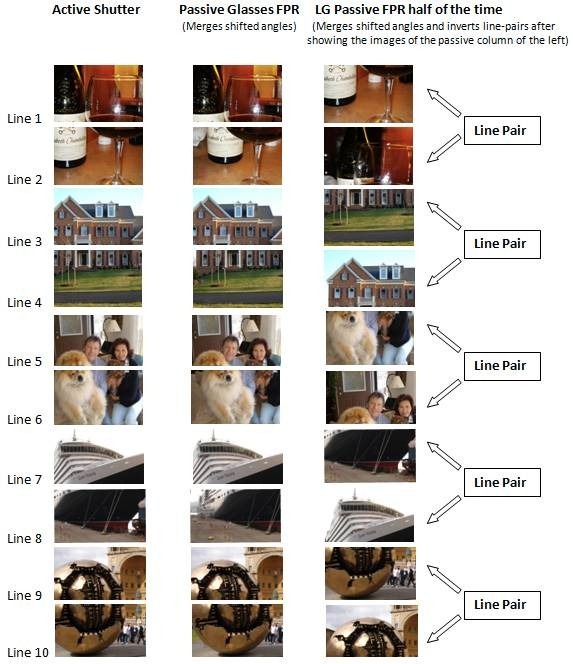
On the previous 4 articles I detailed the differences of the technologies currently in the market for glasses-required 3DTVs, active-shutter and passive polarized. Here is part 1, which links to the other three. I received some questions and remarks from readers and others in the industry regarding the articles. The comments lead me to believe that the concepts are still hard to comprehend by some, so I decided to summarize the subject using a simple visual comparison in one article.
I previously mentioned that one typical difference between the technologies is the 3D glasses, passive glasses are polarized, cheaper, and lighter, active shutter glasses are bulkier and comparatively expensive due to the electronics within them. However, limited information has been published regarding picture quality other than passive technology shows two half-resolution polarized images, and active shutter technology shows two full resolution images alternating them time-sequentially.
LG Display's passive method claims to show the 3D Blu-ray resolution that typical passive 3DTVs ignore, but the 3DTV set still interleaves lines from both angles and renders a half-resolution image on every video frame, but the twist is: it does it with up-side-down video line pairs on its second video cycle. The inverted order is received as is by the 3D glasses and the eyes. Here is a quick visual comparison of a pair of video lines/pixels displayed by the technologies:
Active Shutter (Left Eye)
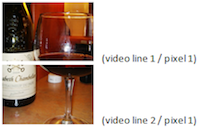
Passive Glasses (Film-Patterned-Retardant) merges left/right half-resolution images all the time
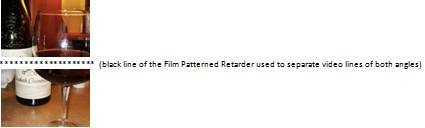
LG's Passive Glasses (FPR), merges left/right half-resolution images, and up-side-down half of the time
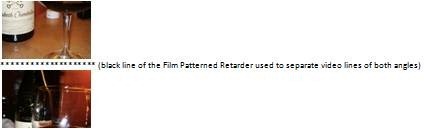
The above shows only two video lines on each technology to highlight the difference. Notice the angle shift of the line-pair of the passive method, it never shows the full image on either angle/eye, and notice LG's interleaving angles with inverted content in the line-pairs during the second 120Hz cycle.
Inverted lines? How would the rest of the image look with more content? As I did before, I show miniature content into the pixels so you can see the details (to facilitate visual comparison I omit the distracting black lines of passive FPR shown above, although they are present on every passive 3DTV):
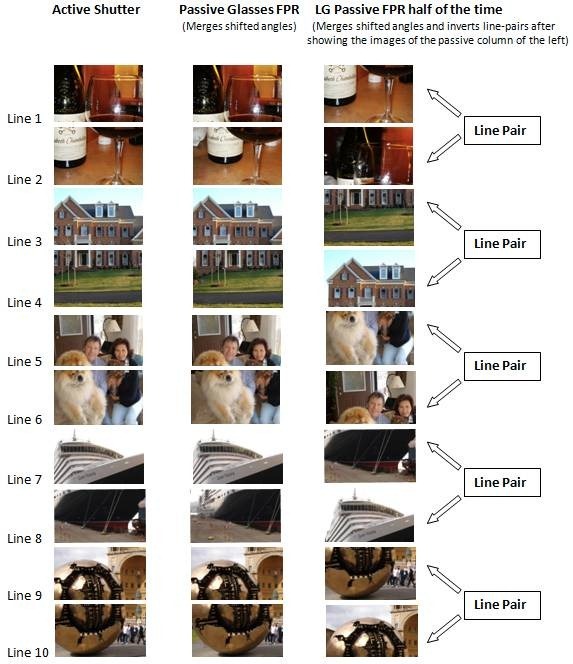
Imagine the rest of the images in the three technologies until line 1080.
Landscaping above the roof?
The Queen Victoria captain's bridge under the ship itself?
My 60-pound Chow levitating above my head?
A wine-glass floating above the neck of the wine-bottle?
The Vatican may question the artistic display of “Arnaldo Pomodoro's donation of Sfera con Sfera (1990) where half “Sfera is floating above its inverted other half.
LG Display claims that their 3DTVs with passive glasses are preferred by viewers and offer 3D images similar to local theaters using the same type of passive 3D glasses. Frankly, the similitude with 3D local theaters starts and ends with the cheap polarized glasses. Typical local 3D theaters do not show half-resolution images; neither they show inverted line-pairs within 3D images.
Some consumers may feel inclined to passive 3DTV because the 3D glasses are cheaper and do not need a thorough evaluation of image quality in 2D and 3D. Additionally, the reality is that 3D viewing is and will be sporadic in the near future, and that 3D is and should be considered as just one more feature of an HDTV primarily used to watch 2D. A concern that should not be overlooked is that the Film Patterned Retarder extra layer of the passive TV screen has the potential to affect the image quality of every day's HD viewing.
However, even when considering all the factors above, some viewers may still prefer passive technology for their own reasons, one example could be if the active-shutter technology has caused visual discomfort or showed unacceptable image crosstalk/flicker when displaying 3D, and under such circumstances the cost of the 3D glasses would be totally irrelevant for the choice. Regardless, both technologies should coexist in parallel rather than battling to displace each other, and on doing that they should respect each other's features, weaknesses, and merits.