HDMI

HDTV and Home Theater Podcast - Podcast #628: New Pioneer Receivers

HDTV and Home Theater Podcast - Podcast #628: New Pioneer Receivers

Pioneer's five new VSX-line receivers mark the first consumer AV receivers to support HDMI 2.0, enabling 4K/60fps passthrough and expanded color depth for Ultra HD displays. The flagship VSX-1124 ($599) pairs an ES9006S DAC running at 192kHz/24-bit with multi-channel FLAC/WAV playback and DSD 2.8 MHz support, while the Elite VSX-80 ($700) adds Crestron and Control4 compatibility with full two-way RS-232C-over-IP control. Buyers evaluating a 4K home theater upgrade will find these receivers cover both high-resolution audio and next-generation video connectivity in a single unit.

The HT Guys
Podcasts

HDTV and Home Theater Podcast - Podcast #625: Gefen TV Wireless Extender for HDMI 60 GHz

The Gefen TV Wireless HDMI Extender (GTV-WHD-60G) operates on the 60 GHz frequency band, delivering uncompressed 1080p Full HD video with near-zero latency (less than one frame) and support for Dolby TrueHD and DTS-HD Master Audio up to 7.1 channels. Its strict line-of-sight requirement limits range to a reliable 33 feet and prevents through-wall use, but blind tests confirmed indistinguishable audio and video quality compared to a wired HDMI connection. At a street price of around $300, it is a strong choice for projector or flat panel installations where signal quality outweighs placement flexibility.

The HT Guys
Podcasts

Living with 4K - Bought an UHDTV? wait, is it Upgradeable?

Early UHDTV adopters face potential obsolescence as the ITU Rec. 2020 standard introduces features beyond 4K pixel resolution, including 10/12-bit color depth, 4:2:2 and 4:4:4 chroma subsampling, HDCP 2.2 content protection, and HDMI 2.0 support for 4K at 60fps - capabilities many current displays cannot handle. Most manufacturers offer no upgrade path, while Samsung's replaceable connectivity box and Sony's in-home hardware upgrades for models like the $25,000 VW-1000 projector represent notable exceptions. Buyers should carefully evaluate upgrade commitments before purchasing, as connectivity gaps similar to the HDTV-to-HDMI transition of 1998-2003 could strand millions of early adopters again.

Rodolfo La Maestra
Articles
Living with 4K - Nuvola 4K Player NP-1

Living with 4K - Nuvola 4K Player NP-1

The Nuvola NP-1 is a $299 4K media player powered by an NVIDIA Tegra 4 quad-core processor with 72 GPU cores, running Android 4.2 and featuring a single HDMI 1.4 output limited to 4:2:0 chroma subsampling at 8-bit depth and 24/30 fps. It supports H.264-based 4K streaming and local playback via USB 3.0 storage, with H.265/HEVC support promised via firmware update, but its single-HDMI design forces buyers to use an HDMI splitter or sacrifice multichannel audio. Compared to Sony's $699 FMP-X1, the NP-1 offers broader TV compatibility and lower cost, though its video and audio connectivity limitations have real consequences for home theater installations.

Rodolfo La Maestra
Articles

HDTV and Home Theater Podcast - Podcast #599: HDMI 2.0 Announced

HDMI 2.0 raises bandwidth from 10.2Gbps to 18Gbps, enabling 4K video at 60fps compared to the 30fps ceiling of HDMI 1.4, along with support for up to 32 audio channels and a dramatic jump in audio sample frequency from 192kHz to 1536kHz. The spec also introduces simultaneous dual video streams and up to four independent multi-channel audio streams on a single cable. Practically, upgrading to HDMI 2.0 requires new source equipment, a receiver, and a display, but existing Category 2 High Speed HDMI cables remain compatible with most features.

The HT Guys
Podcasts

HDTV Expert - HDMI 2.0 Is Here...And It's Not Fast Enough?

HDMI 2.0 arrives with a maximum data rate of 18 Gb/s, edging past DisplayPort's 17.2 Gb/s and enabling 4K at 50/60 Hz with 8-bit color, while also adding up to 32 audio channels and a 1536 kHz audio sample frequency. However, the standard falls short of supporting 10-bit and 12-bit 4K at frame rates above 60 Hz, which are prerequisites for high dynamic range video, and omits a high-speed data bus overlay increasingly demanded by modern devices. Consumers and integrators adopting HDMI 2.0 can use existing Category 2 cables, but should understand this is an incremental update rather than the future-proof leap many anticipated.

Pete Putman
Columns

HDTV and Home Theater Podcast - Podcast #590: HDMI 1.4a and Beyond

HDMI 1.4a delivers a feature set that includes the HDMI Ethernet Channel (HEC), which allows a single network connection to be shared across multiple devices over a standard HDMI cable, and the Audio Return Channel (ARC), which eliminates the need for a separate cable to pass Dolby Digital audio back to a receiver. The spec also defines 4K resolution support, 3D video input/output protocols, and a Micro Connector supporting up to 1080p for portable devices. Looking ahead, version 1.4b adds 1080p at 120 Hz, while the newly formed HDMI Forum is targeting version 2.0 with increased bandwidth and improved mobile device support.

The HT Guys
Podcasts

HDTV and Home Theater Podcast - Podcast #570: HDMI Cable Throwdown, High Priced vs Generic

A controlled channel-change speed test pits a $6 Monoprice HDMI cable against a $70 AudioQuest Cinnamon 1m HDMI cable, measuring lock times across mixed 720p and 1080i resolution switches on a satellite receiver. Averaged across three runs, the Monoprice cable locked in 4.10 seconds versus 3.90 seconds for the AudioQuest, a difference of just 0.2 seconds. For consumers weighing cable upgrades, the data suggests a generic HDMI cable delivers effectively identical real-world performance at a fraction of the cost.

The HT Guys
Podcasts

HDTV and Home Theater Podcast - Podcast #569: Wireless HDMI Options

Wireless HDMI systems from Belkin, IOGEAR, Brite-View, and others are compared across key specs including 5 GHz transmission, 1080p support, and through-wall range claims of up to 150 feet. Real-world testing reveals that advertised 100-foot through-wall distances are rarely achievable, with practical limits closer to 30-40 feet, and line-of-sight systems risk signal loss when someone walks through the beam. For home theater enthusiasts considering a front projector or a wall-mounted TV away from cable outlets, current pricing between $189 and $240 makes wireless HDMI a viable option worth evaluating.

The HT Guys
Podcasts

HDTV Expert - 4K: HDTV Redux? - by Pete Putman

4K acquisition and display technology faces a convergence of familiar challenges, including a live 4K baseball broadcast in Japan transmitted at 120 Mb/s and Fox Sports deploying Sony F65 cameras for NFL referee reviews. On the consumer side, Hisense's XT-880 series targets 50- to 65-inch screens at CES 2013, while HDMI remains bottlenecked at 8 Gb/s, struggling to deliver 3840x2160 content above 30 Hz - a gap that DisplayPort at 17.2 Gb/s and an emerging HDMI 2.0 specification aim to close.

Pete Putman
Columns
HDTV and Home Theater Podcast - Podcast #498: Accell UltraCat HD

HDTV and Home Theater Podcast - Podcast #498: Accell UltraCat HD

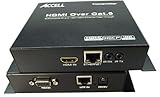
The Accell UltraCat HD is an HDBaseT-based HDMI extender capable of transmitting video up to 330 feet over a single Cat5e/6 Ethernet cable, supporting 1080p/60Hz at 48 bits, 4K, 3D, HDCP compliance, and lossless audio formats including Dolby TrueHD and DTS-HD. Testing at 100 feet confirmed zero signal degradation from both a satellite source and a Blu-ray player feeding an AV receiver, doubling the maximum reliable HDMI cable run previously achieved. At $500 MSRP, this extender is a practical solution for long-distance HDMI runs to projectors or displays where standard cables fall short.

The HT Guys
Podcasts
HDTV and Home Theater Podcast - Podcast #496: ZyXEL AeroBeam Wireless HD Video Kit

HDTV and Home Theater Podcast - Podcast #496: ZyXEL AeroBeam Wireless HD Video Kit

The ZyXEL AeroBeam Wireless HD Video Kit (WHD6215) operates on the 60GHz WirelessHD 1.0 standard with a maximum throughput of 4Gbps, supporting resolutions up to 1080p 3D and 7.1-channel surround sound. Priced at $218 online, it requires direct line-of-sight within 30 feet and lacks IR signal tunneling, limiting installation flexibility compared to competing units. However, its video quality - delivering sharper images and more vivid colors than other tested wireless HDMI solutions - makes it a compelling choice for front projector or flat-panel setups where picture fidelity is the priority.

The HT Guys
Podcasts

HDTV Almanac - Thin HDMI Cables Are Smart

Redmere, an Irish company, has developed active HDMI cable technology that embeds signal-boosting circuitry inside the end connector, producing cables that are 70% to 80% thinner and lighter than standard passive HDMI cables while supporting runs up to 50 feet. The technology is already available through brands such as VIZIO, Samsung, Monster, and Radio Shack, with some models priced under $25. For consumers who need portable or long-run HDMI connections, this approach delivers full signal integrity without the bulk of conventional cables.

Alfred Poor
Columns

HDTV and Home Theater Podcast - Podcast #479: HDMI 1.5 Wish List

HDMI has evolved from version 1.1 in 2006 to 1.4a in March 2010, adding support for 4K resolutions up to 4096x2160p at 24 Hz, Audio Return Channel, 3D formats, and a 10.2 Gbps data rate along the way. This podcast episode speculates on a potential HDMI 1.5 specification, proposing features such as power delivery over the cable, standardized universal remote command routing across manufacturers, and home automation integration to eliminate RS-232 wiring. For consumers, these additions could simplify multi-device setups and reduce dependence on proprietary control systems.

The HT Guys
Podcasts

HDTV Almanac - Banned at the Border

HDMI Licensing, the body overseeing intellectual property for the HDMI standard backed by over 1,000 licensed companies, has partnered with U.S. Customs and Border Protection to seize 32 shipments of counterfeit HDMI products at ports spanning Alaska to Florida. The seized goods ranged from cables to DVD players, targeting manufacturers who bypassed required patent licensing. For consumers, the enforcement has not disrupted supply or pricing, as quality HDMI cables remain available for under $10, and the digital connection's pass/fail nature means a budget cable performs identically to a premium one.

Alfred Poor
Columns