Market Trends & Analysis

HDTV Expert - Consumer Television: It's Business As Usual (Or Maybe Not)

Samsung sold an estimated 49 million flat-panel TVs in 2013, cementing eight consecutive years at the top of the global television market, while Samsung and LG together command over 40% of worldwide TV share. Sony and Sharp continue bleeding market share, with Sharp holding just 5% globally and 3% in the U.S. as of Q3 2013, and LG's 55-inch curved OLED has already dropped 67% in price to roughly $4,910 in the UK. Vizio's new full-array LED 4K smart TVs, starting at $1,000 for a 50-inch model, signal further price compression that threatens premium-tier manufacturers.

Pete Putman
Columns

HDTV and Home Theater Podcast - Podcast #619: What's Hot Right Now (2014 Time Capsule)

A 2014 snapshot of the consumer TV and streaming market reveals a landscape in transition, with 4K sets just beginning to appear (a single 39-inch Seiki 3840x2160 panel at $599 cracking the top 100) while 1080p LCD dominates and plasma shrinks to just 5 top-100 entries. OLED remained a fringe category with only two curved models available, both priced near $9,000. For buyers tracking value, the data shows a 75-inch 1080p Smart LED TV at $2,658 undercutting a 65-inch model from two years prior by roughly $1,000.

The HT Guys
Podcasts
HDTV Expert - CES 2014 In The Rear-View Mirror

HDTV Expert - CES 2014 In The Rear-View Mirror

CES 2014 showcased a wave of 4K LCD and OLED televisions, with HEVC H.265 encoding poised to halve required bit rates and enable 4K streaming at roughly 10-20 Mb/s over existing broadband infrastructure. Quantum dot film technology, already deployed in Sony's 55-inch and 65-inch 4K LCD TVs, offers a compelling alternative to OLED by delivering stable, narrow-bandwidth color without the differential blue-emitter aging that threatens OLED longevity beyond 5,000 hours. Consumers weighing early adoption of these technologies will find the display interface landscape still evolving, with HDMI 2.0 capped at 18 Gb/s and DisplayPort 1.3 promising higher headroom for 10-bit 4K at 60 Hz.

Pete Putman
Columns
HDTV Expert - CES 2014: First Impressions (4K, Curved Screens, OLEDs, and All That)

HDTV Expert - CES 2014: First Impressions (4K, Curved Screens, OLEDs, and All That)

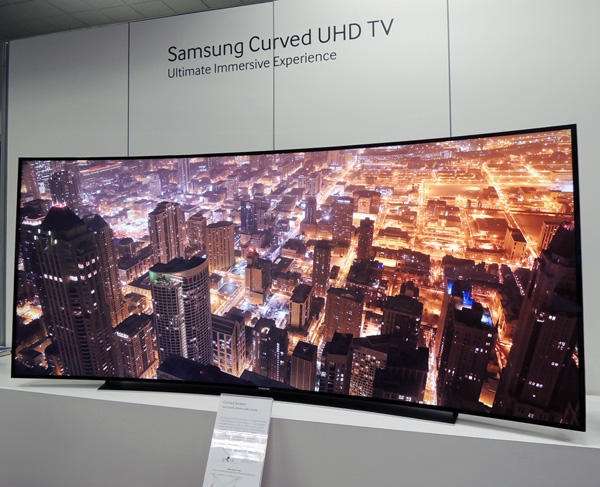
CES 2014 brought a wave of large-format display technology, highlighted by three manufacturers unveiling 105-inch 21:9 curved 4K LCD TVs, LG's 77-inch curved 4K OLED as the world's largest, and Vizio's 120-inch 4K LCD using Sharp's Gen 10 ASV glass from Sakai, Japan. Chinese manufacturers replicated nearly every Samsung and LG breakthrough with far less fanfare, while Panasonic's conspicuous absence of a consumer LCD lineup signals a potential exit from the TV market. For buyers, the practical takeaway is that large 4K LCDs are on track to become the standard within 2-3 years, with competitive pricing pressure accelerating from Chinese brands.

Pete Putman
Columns

HDTV Expert - Smartphones vs. Digital Cameras: The Death Knell?

Digital camera shipments fell for a third consecutive year, with CIPA data showing a 19 percent drop in worldwide camera shipments in August 2013 and point-and-shoot volumes down 40 percent year-over-year by late 2012, while even Canon's DSLR segment declined for the first time. Nikon's D3200, a 24.2-megapixel DSLR capable of 1080p/60 video at $497, illustrates how flagship specs now compete directly against smartphone convenience at a fraction of the cost. For consumers, the calculus increasingly favors smartphones that combine adequate image quality with instant social sharing, portability, and multifunctionality over dedicated cameras.

Pete Putman
Columns

HDTV and Home Theater Podcast - Podcast #615: Prediction Results for 2013

A year-end review of 2013 HDTV and home theater predictions scores a combined 2 out of 10 correct calls, with the standout hit being Panasonic's confirmed exit from the plasma TV business, effectively ending the flat-screen technology it helped pioneer. Predictions that missed include Apple entering home automation, 42-inch 1080p LCD TVs dropping to $300 from $480, and new-release streaming via all-you-can-eat subscription services. Readers tracking the consumer electronics landscape will find useful context on where the industry landed versus expectations heading into 2014.

The HT Guys
Podcasts

HDTV Expert - Black Friday: Boom, Or Bust?

Black Friday 2013 retail data presents a contradictory picture: while total weekend spending was estimated at $57.4B and online purchases hit a record 40% of all transactions, Black Friday brick-and-mortar sales actually declined 13.2% from 2012, cannibalized by earlier Thanksgiving store openings. Mobile devices accounted for 40% of online traffic and roughly 22-26% of online sales, with smartphones driving 25% of Friday shopping traffic. Electronics and Blu-ray discs ranked among the top four in-store purchases, yet Walmart, Target, and Best Buy all lowered quarterly expectations amid sliding consumer confidence.

Pete Putman
Columns

HDTV Expert - Mixed Signals about UHDTV

Ultra HD (4K) television technology dominated multiple New York-area industry events, with key debates centering on content delivery pipelines, interface limitations such as HDMI 2.0's inability to handle high frame rate 2160p with deep color, and the readiness of H.265 encoder chips. Consumer spending data from CEA shows only 2.6% growth in tech gift spending for 2013, while 4K sets retail at roughly $65 per diagonal inch compared to $15 for standard 2K displays. Chinese manufacturers like TCL are already shipping 50-inch 4K TVs at $999, signaling potential price disruption that could accelerate mainstream adoption despite an incomplete ecosystem.

Pete Putman
Columns

HDTV Expert - UHD-TV, Small OLEDs, and Market Forecasting

UHD-TV (4K) panel shipments reached 0.4 million units in Q2 2013, with IHS Displaybank projecting 1% unit penetration in 2013 rising to 8% by 2017 and revenue penetration hitting 20% by 2017 - figures the author finds credible despite the inherent unreliability of early-lifecycle market forecasts. Samsung's years-long struggle to achieve high-yield, low-cost manufacturing of small OLED displays serves as a cautionary parallel for how difficult new display technologies can be to scale. For consumers, the near-term question is whether aggressively priced Chinese and Japanese UHD-TV sets will deliver genuine 4K image quality.

Ken Werner
Columns

HDTV Expert - Who ARE Those Guys?

Chinese LCD TV manufacturers like BOE Technology and TCL are rapidly gaining market share in the 4K UHDTV segment, with BOE posting an 8.9 percent operating margin and CSOT achieving 9.6 percent in Q2 2013, outpacing LG Display's 5.6 percent. Global 4K TV shipments multiplied 20 times in roughly a year, driven largely by China's 28 percent year-over-year TV shipment growth. For consumers, this competitive pressure is already collapsing 4K pricing from roughly $300 per diagonal inch in 2012 to around $90-$100 today.

Pete Putman
Columns

HDTV Expert - DEG: Here's The Rest of the Story

The Digital Entertainment Group's mid-2013 home entertainment report buries significant declines behind optimistic headlines, with overall DVD and Blu-ray disc sales falling 4.7% year-over-year to $3.6 billion while subscription streaming surged 32% to $1.5 billion. Physical disc rentals across all channels continued a multi-year contraction, and the 61 million Blu-ray players cited by DEG increasingly function as streaming media boxes rather than disc players. The looming implementation of MPEG-4 H.265 (HEVC) encoding, enabling 1080p/60 streams at 2-3 Mb/s, suggests the shift away from packaged media will only accelerate.

Pete Putman
Columns

HDTV Expert - Zero-TV Households and the Second-Season Crunch

Nielsen's Q4 2012 Cross-Platform Report identifies over 5 million Zero-TV households, up from 2 million in 2007, with 67% consuming video via PCs, smartphones, and tablets rather than traditional sets. Network broadcast ratings are declining sharply, with shows like New Girl dropping from 8.4 to 6.16 million viewers in their second season, while cable originals such as Homeland and Game of Thrones command stronger audience loyalty. Notably, 23% of Netflix subscribers have cancelled cable or satellite subscriptions, signaling a structural shift that improved smart TVs and faster streaming will likely accelerate.

Ken Werner
Columns

HDTV and Home Theater Podcast - Podcast #581: TV Buying Trends and an Interview with OpenRemote.org

An analysis of Amazon's top 10 best-selling HDTVs reveals that Samsung and Vizio together dominate 80% of the list, with models ranging from a $229.99 Samsung UN32EH4003 32-inch 720p LED to a $1,499.99 Panasonic TC-P60ST60 60-inch 1080p 600Hz 3D Smart Plasma. Nine of the ten sets are LED-backlit, while the lone plasma entry from Panasonic holds the largest screen size and highest price point by a significant margin. Sony's absence from the top 100 until position 55 signals a meaningful shift in consumer purchasing behavior worth tracking for anyone shopping the mid-range TV market.

The HT Guys
Podcasts

HDTV Adoption - Not as High in Number of HDTV Sets

CEA data shows 244 million DTVs shipped since 1998, representing 68% penetration of the estimated 357 million TV sets in U.S. households (119 million households at 3 TVs each), yet Leichtman Research Group survey data extrapolates to as many as 198 million analog TVs still in use, or 55% of all sets. The gap between household-level adoption figures (CEA's 68-88%) and actual TV-set-level penetration reveals a more sobering picture of the DTV transition. At the current shipping rate of roughly 33 million DTVs per year, full analog replacement could take 4 to 6 additional years, excluding sets that replace already-digital units.

Rodolfo La Maestra
Articles

HDTV Expert - Apple Must Become Phabulous

Apple's absence from the phablet segment poses a growing competitive risk, as ABI Research projects over 150 million phablet shipments in 2013, representing 18% of all smartphone demand. While ABI defines phablets as devices with screens 4.6 inches or larger, a more defensible threshold starts at 5 inches, where rivals like the Samsung Galaxy Note II (5.5-inch, 1280x720 AMOLED) and LG Optimus G Pro (5.5-inch, 1920x1080, 400ppi) set the benchmark. Apple's iPhone 5, with its 4-inch display, lags well behind these specifications, raising real questions about its smartphone competitiveness.

Pete Putman
Columns