
3D World Conference 2011 in NYC: Are you ready for 4K? How about 3D in 4K?
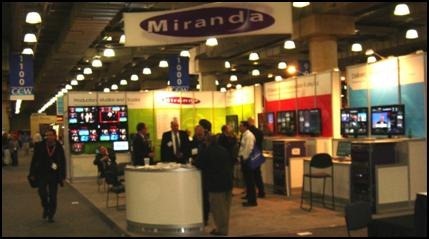
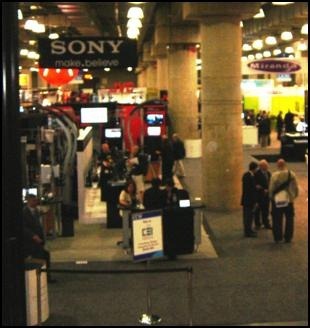
Last week I attended the 3D World conference at the Content and Communications World (CCW) 2011 in NYC. Although my main interest has been the professional aspects of the 3D industry from content acquisition to display devices I always find interesting other digital TV subjects and initiatives in conference tracks and discussion panels, this time 4K was very notorious. As I did in 3D World 2009 and in 2010 I flew in and out of NYC the same day so I had to make my conference day as effective as possible, this was a long day indeed.
HDTV Magazine is a sponsor of this conference and I wanted to be present. I did not plan to write about the event, but that changed when I noticed the 4K coverage. So what was the 3D World about this year? It was very obvious that the industry is looking again to sell more technology to consumers after 13 years of HDTV, about 6 years of 1080p, 5 of Blu-ray, and 2 of 3DTV. For them it was time for another pocket shocker, actually the pocket shocker never stopped.
Who needs 4K?
One thing is having James Cameron looking for better quality image on filming his new Avatar 2, more resolution such as 4K3D, and faster shooting speed to smooth out the frame rates of 3D imaging, such as the 48 frames-per-second, 60 fps, or even higher he commented recently, rather than the typical 24fps.
Another very different thing is applying the same approach for the “in-between steps in the food chain of equipment and transmission after the camera/production point all the way to the display device at home, including broadcasting, pre-recorded media, HDMI standards, wiring, A/V equipment, enhanced compression algorithms, and the TV itself. Such idea naturally motivates a “not-again natural reaction from consumers.
In that regard the “Demystifying 4K Resolution: From Scene to Seen panel commented that using 4K cameras for creating content not necessarily expects 4K distribution and display, but has the benefit of making a more detailed original of the content, compared to creating it with HDTV cameras, for various future uses.
On his presentation of “4K/2K End-to-End - The Sony 4K Roadmap Hugo Gaggioni, Chief Technology Officer for the Broadcast and Production Systems Division of Sony Electronics, indicated that a 4K CCD
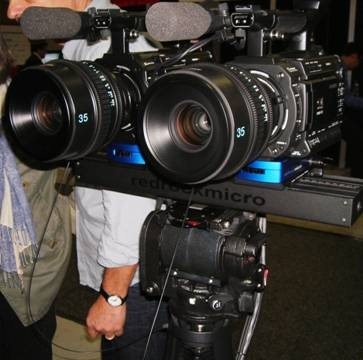
Sony 3D Camera Rig
Although not exactly the same spatial resolution of the video frame, 2K digital cinema resolution for theaters (2048x1080) is close to HDTV resolution (1920x1080), and 4K is often misinterpreted as the double of 2K resolution by many that just look at the doubled number.
Actually the doubling in the 4K nomenclature is referring to the gross number of pixels in the horizontal axis of the video frame (4096), the total resolution of a 4K video frame is about 4 times the HDTV resolution because it doubles the spatial resolution of the video frame in both directions, 2x horizontally (from 2048 to 4096) and 2x vertically (from 1080 to 2160).
The conference discussed the subject of 4K on several panels and tracks, and of course also 3D from image acquisition to displays. One track was dedicated to analyze the consequences of bad and good 3D, and how bad 3D could harm the 3D industry and the public appreciation and acceptance of 3D in general if the only 3D they have seen is a bad 3D movie (Clash of the Titans comes to mind), or seen a movie that exploits rapid or excessive fluctuations of negative to/from positive parallax (objects seen behind the screen plane switching to in-front, and with excessive depth) which may produce visual discomfort to some, a condition that well made 3D should not cause to most viewers.
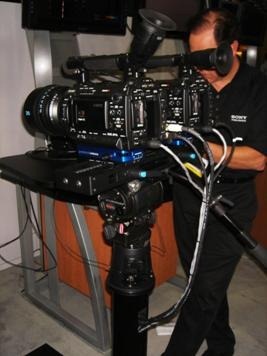
Sony 3D Camera Rig From Back
Depending on the video processing capabilities of the new 4K consumer projectors this may bring new opportunities to bring to market good quality 4K scalers, the same way they did for 1080p 5 years ago, and likewise it would require that the 4K projector is capable to accept 4K content as input, a feature the new Sony projector has but not the JVC (mentioned below). I am making this comment because some of the first impressions of the Sony's HD-to-4K upscaling processing of the new projector at CEDIA 2011 were not as good as expected, although true 4K content displayed well, more tests are required to elaborate further, and the projector is not even out yet.
How to deal with the in-between steps of the 4K chain is still fuzzy, but it was clear that in order to start creating high quaity 4K content, or to display upscaled HD in 4K displays, there is no immediate need to have every step of the content distribution chain capable of 4K/3D4K, although 4K Blu-ray is already in the works and we already know that the ATSC is already working in a higher quality TV broadcast standard, which also includes 3D and other features of quality.
Meanwhile manufacturers of displays are salivating again while anticipating more sales of new toys, and many home-theater aficionados are salivating as well, especially the ones with large CinemaScope screens looking for high quality imaging.
Just recently a couple of companies announced 4K projectors for consumers at CEDIA 2011, four from JVC ($8K to $12K, available in November mentioned further below, with 3840x2160 resolution, which is not actually 4K by the book but is exactly 4 times of 16x9 HDTV 1920x1080), and one from Sony, the VPL-VW1000ES <$25K, 4096x2160 (true Digital Cinema Initiative 4K resolution), shipping in December thru professional installers.
Lee Turvey - District Sales Manager of Quantel
The 4K consumer grade projectors are offered at relatively reasonable prices considering the very high pricing of some current Sony 4K projectors, or even earlier 4K projectors for movie theater applications, such as the Sony's SRX-R110 introduced in 2005 and shown again at CES 2007 ($80K+$15K lens, shown in page 101 of the HDTV Technology Review consumer edition - free pdf, or in page 169 of the industry edition book), if I recall correctly only the lamp for that projector cost about $3K.
Another example is Sony's SRX-R220 for about $220K including lens, or the SRXR320p for digital cinemas, or JVC's old DLA-SH4K and DLA RS-4000 4K projector for $175K.
However, regarding JVC's new 4K projectors the devil is in the detail, the projector from JVC does not accept 4K resolution as input, and uses an “e-Shift display method that claims to render a 4K “precision in the displayed image without actually using a full resolution 4K DiLA chip, and I quote from JVC's press release “available in the DLA-X90R, DLA-X70R, DLA-RS65 and DLA-RS55. Using e-Shift, 2D HD content is upconverted and scaled to a 4K signal (3840 x 2160) and the e-Shift technology displays it at full 4K precision. Compared to a Full HD (1920 x 1080) image, that's twice the horizontal and vertical resolution and four times the number of pixels, or over 8 megapixels. The result is a stunningly detailed image with minimal aliasing artifacts found in standard HD displays.
This immediately triggered memories of Texas Instruments' “wobulated DLP chips that in 2004 claimed to render images with full 1920 pixels of horizontal resolution while actually using a 960 pixel/mirrors array in the chip, implemented in rear-projection TVs such as Mitsubishi (page 49 of the 2005 HDTV Technology Review, free as well). The JVC uses an electronic/optical approach but for similar purposes.
The new Sony VPL-VW1000ES 4K projector claims that HDTV sources and Blu-ray content would be scaled up to 4K, which means 75% of every video frame would be pixel-interpolated, a scaling creation of its video processor using the other 25% of the image as a base (the original pixels in each video f
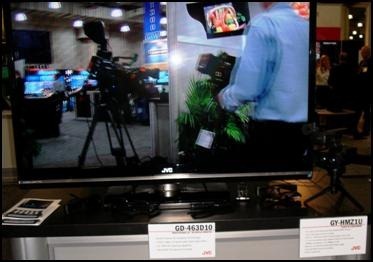
JVC demo of 3D passive LCD panel with their 3D camcorder
4K on 3D?
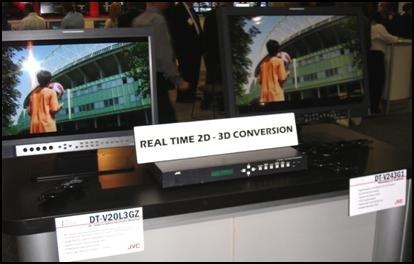
JVC demo of professional Real Time 2D - 3D Conversion
In January at CES 2011 Toshiba and Sony also showed 4K prototype panels for auto-stereoscopic (no-glasses) 3D as well, not that the 3D effect was great but the panel resolution showed the companies direction toward 4K also for HDTV images.
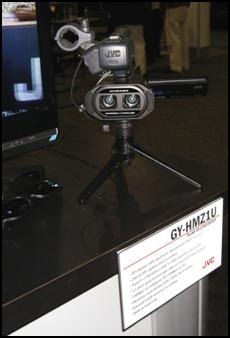
JVC's 3D consumer camcorder
3DFusion has now the auto-stereoscopic panel available on the street and as expected is offered at an initial relatively high price tag ($10K) but it clearly shows that glasses-free 3DTV is available now, not in 10 years as many claimed.
3DFusion's 42" Auto-Stereoscopic-Display with PC, media player, software, and remote control is already available and all are included in the $10K. The same applies to the ZL2 55 panel for no-glasses 3D and 4K from Toshiba (recently announced as a product for $11K+).
The feature of higher resolution renders more detailed images and allows for closer viewing distances, which increases the lateral angle of view, which excites wider areas of the peripheral vision immersing the viewer further into a movie, much beyond the 30%+ THX or SMPTE standards for 1080p.
This immersion factor is especially important for 3D content, which cannot convey the same cinema depth effect on small TV screens if viewed from afar. In other words, 3D is better in large screens, and 4K facilitates more quality in large screens, the union of both is positive for an overall 3D experience.
If you are reading this magazine you are not a regular consumer looking for a small CRT for your family room, but many are just coming out of recent technology upgrades such as HDTV panels, Blu-ray, 3D etc. So here is the question, are you ready for 4K? About for 3D 4K? Do you have a screen that would allow you to notice the increase in 4K image quality even when you cannot see now the individual pixels of 1080p from your current viewing distance? Perhaps this is the time for your dream home-theater.