
Displaying 3DTV Images - What is Wrong with this Picture
The first article on this series covered the battle of passive vs. active 3DTV methods. This second article is a teaser to make you think about how much our brain is expected to work when viewing passive 3DTV images.
Each pixel of a TV is important, larger objects in an image show sharper when their pixels show accurate information, every pixel counts regarding image quality. Let us go down to the pixel level.
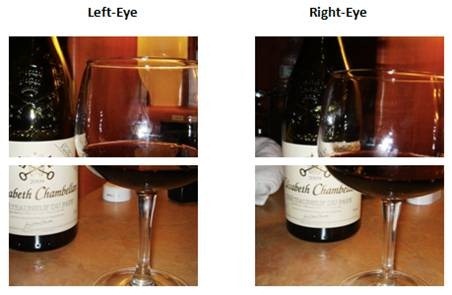
Imagine each picture below (figure-A with 4 pictures) as occupying one whole pixel of a 3DTV image. In order to display the wine bottle with the glass the TV would then need 2 pixels (one above, one below, in two lines of video).
Since 3D is made of a recorded image-pair of the objects in front of the 3D camera (same objects viewed from two angles simultaneously), the 3DTV on this example would receive 2 pixels for the left eye (represented by the pictures in the left column) and two pixels for the right eye (represented by the pictures in the right column).
An active-shutter 3DTV would show the two pixels for the left eye first, and quickly after it would show the two pixels for the right eye, the brain would blend the pixels as information of the left/right angles and interpret the resulting effect as depth. An active-shutter 3DTV would show all the pixels of the original 3D images in their corresponding relative positions within the image-pair as shown in figure-A and both images are shown at full resolution.
Figure A - Source 3D images
Now imagine (figure-B) how an image would be produced by a passive 3DTV considering that it interleaves the two angles, whereby half of the lines of the left image are merged with half of the lines from the right image. Imagine how the eyes would see them considering that half of the original information from each angle has been discarded, and imagine which pixels from the source images would be shown in which order and in which location within the displayed image (shown in figure-B).
Figure B - Typical Display Method of Passive 3DTVs - Interleaving lines/pixels from both Angles.

Notice the background shift when the two pixels from different angles are displayed above/below in a single image at once, regardless which eye sees which pixel. As mentioned before, the passive method discards half of the original resolution (even video lines of left images, and odd video lines of right images).
In this example it discards the second video line of the left image (bottom pixel in the example), and the first line of the right image (top pixel in the example). The TV does the same for all the remaining video lines on every image-pair. The discarded pixels are not displayed by the TV even if the TV would be capable to display video frames faster than 120 frames-per-second (120Hz) per eye.
Moreover, imagine an LG's passive 3DTV claiming to show all the remaining pixels (depicted further down in figure-C) of the half-resolution that was discarded by the typical passive method (figure-B).
Figure C - LG Passive Display Method shows the Original Image's Discarded Pixels
LG's method claims and actually displays the discarded pixels immediately after showing the pixel-pair of figure-B (overlapping the same pixel positions).

Notice anything interesting (what is on top of what)?
Imagine completing the image with the same pixel-mix above on the remaining 2,073,598 pixels of the video frame (1920x1080 - 2) of either figure B or C.
Imagine the effect of alternating the display of figure-B and figure-C images 120 times per second, as done by LG 3DTVs.
Some viewers are said to experience discomfort when viewing 3DTV with active-shutter glasses, I wonder how that discomfort compares with the brain effort required to reconstruct the pixel structure shown by passive 3DTVs, not to mention LG's.
Add to that factor the typical blurriness (click on "Watch", then click on "240Hz") weakness (click on "Trumotion 480Hz") of LCD technology due to pixel-response-time and sample-and-hold style of operation (plasmas do not use the passive method), and the low cost of passive 3DTV glasses may become a minor factor when choosing a 3DTV if image quality is of concern.
My next articles will expand the subject further. Stay tuned.